Contents Covered
- What Is an LEI?
- Who Needs an LEI?
- Benefits of Having an LEI
- Process to Avail an LEI (India)
- Cost to Avail an LEI (India)
- Conclusion
If you run a business that deals with banks, large transactions, or capital markets, you’ve probably come across the term “LEI” somewhere in a compliance form or loan document. It sounds like just another regulatory acronym — but it’s quietly become one of the most important identity codes in global finance. This post breaks down what an LEI is, who actually needs one, why it matters, and how (and at what cost) you can get one.
What Is an LEI?
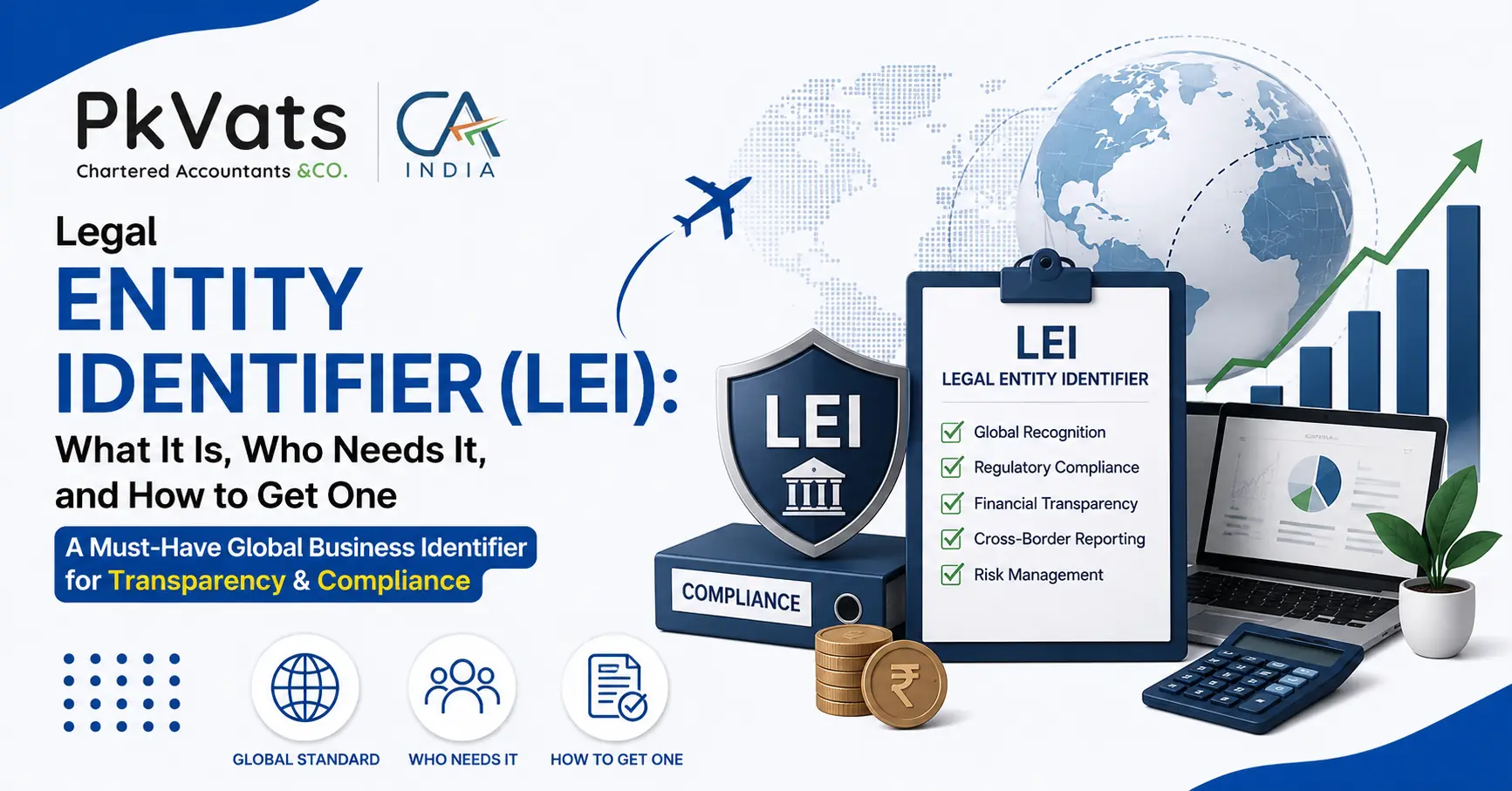
A Legal Entity Identifier (LEI) is a unique, 20-character alphanumeric code assigned to a legal entity — a company, trust, fund, partnership, or any other organization that takes part in financial transactions. It follows the ISO 17442 standard and is designed to answer a simple but surprisingly hard question in global finance: who exactly is on the other side of this transaction?
The system was created in response to the 2008 global financial crisis, when regulators discovered that many institutions couldn’t accurately trace counterparty relationships across borders because every country — and often every bank — used its own internal identifiers. The LEI created a single, globally consistent identity code instead.
The system is overseen by the Global Legal Entity Identifier Foundation (GLEIF), a not-for-profit body established under the Financial Stability Board. GLEIF doesn’t issue LEIs directly; instead, it accredits Local Operating Units (LOUs) in different countries to issue and manage them. In India, the recognised issuer is Legal Entity Identifier India Limited (LEIL), a wholly owned subsidiary of the Clearing Corporation of India Ltd. (CCIL), and it is recognised by the Reserve Bank of India (RBI) under the Payment and Settlement Systems Act, 2007.
Each LEI also links to a public record containing key reference data — the entity’s legal name, registered address, registration authority, and, where applicable, information about its parent and ultimate parent company. This is what makes the LEI more than just a number: it’s a verified, publicly searchable identity.
Who Needs an LEI?
LEIs are no longer a niche requirement for large multinational banks. In India, the RBI has steadily widened the mandate, and today it applies to a broad set of entities, including:
- Companies undertaking large-value transactions — RBI rules require an LEI for entities involved in RTGS/NEFT transactions above a specified threshold.
- Borrowers with large credit exposures — companies availing loans above certain limits from banks and financial institutions.
- Non-Banking Financial Companies (NBFCs) and other RBI-regulated entities.
- Participants in the derivatives, forex, and money markets regulated by the RBI.
- Entities registered with SEBI — including those involved in the securities market, mutual funds, and Alternative Investment Funds (AIFs).
- Corporate treasurers and finance departments of mid-to-large companies that regularly deal with banks, bond issuances, or cross-border settlements.
- Holding companies and their subsidiaries, which may need to disclose parent–subsidiary relationships as part of their LEI registration.
As the phased rollout has progressed, the threshold for mandatory LEI registration has moved lower — meaning even mid-sized companies that weren’t required to register a few years ago may now fall within scope. If your company borrows at scale, transacts in large amounts, or operates across borders, it’s worth checking whether you already need one.
Benefits of Having an LEI
Beyond regulatory compliance, an LEI offers real, practical advantages:
- Faster due diligence. Banks and counterparties can instantly verify who they’re dealing with, reducing onboarding time and paperwork.
- Uninterrupted access to credit and payments. Without a valid LEI, banks may be unable to process large-value RTGS/NEFT transfers or sanction/renew loans for eligible entities.
- Global recognition. A single LEI is valid across all jurisdictions and financial markets worldwide — no need for multiple local identifiers.
- Improved transparency. Since ownership and parent-company data are publicly available, an LEI signals credibility to lenders, investors, and business partners.
- Reduced operational risk. Standardized entity identification reduces reconciliation errors and mismatches in financial reporting.
- Smoother cross-border transactions. For companies engaged in international trade or capital markets, an LEI simplifies compliance with foreign regulators as well.
In short, the LEI isn’t just a box to tick — it’s increasingly treated by banks and regulators as proof that an entity is transparent, verifiable, and low-risk to transact with.
Process to Avail an LEI (India)
Getting an LEI is a fairly straightforward, largely online process. Here’s how it typically works when applying through LEIL, India’s recognised issuer:
- Register on the LEIL portal. Create a user account on LEIL’s official website and choose the type of application — new registration, renewal, or transfer.
- Fill in entity details. Provide the legal name, registered address, incorporation details, and relevant identifiers (such as CIN/PAN) of your entity.
- Submit supporting documents. These generally include the Certificate of Incorporation, PAN card copy, Board Resolution authorising the application, an Undertaking-cum-Indemnity, and audited financial statements. Holding companies or ultimate parent entities also need to submit an Auditor’s Certificate confirming consolidated relationships, along with details of parent/subsidiary linkages.
- Authorised signatory declaration. A duly authorised signatory must submit a declaration confirming the entity is bound by LEIL’s policies and is authorised to apply.
- Make the payment. Fees can be paid online.
- Verification. LEIL cross-checks the submitted details against records from the Ministry of Corporate Affairs (MCA) and other relevant authorities. This typically takes about 3–10 business days.
- Receive your LEI. Once verified, you’ll get a unique 20-character LEI code along with a certificate you can download from your dashboard.
It’s worth noting that instead of applying directly to LEIL, many businesses use Registration Agents (third-party service providers) who handle documentation and follow-ups on their behalf — usually for an additional service fee.
Once issued, an LEI is valid for one year and must be renewed annually. A lapsed LEI is marked “expired” in the global GLEIF database and is treated by banks as equivalent to having no LEI at all — so timely renewal matters as much as the initial registration.
Cost to Avail an LEI (India)
As of the current fee schedule from LEIL:
| Service | Fee (incl. GST) |
| New LEI Registration | ₹10,000/- |
Conclusion
The Legal Entity Identifier has moved from being a checkbox for large multinational banks to a practical necessity for a growing range of Indian businesses — from NBFCs and AIFs to mid-sized companies with sizeable loans or large-value transactions. It’s not just about regulatory compliance; a valid LEI makes your business easier to verify, faster to onboard, and more credible to lenders and counterparties, both in India and globally.
If your company borrows heavily, transacts in high values, or deals across borders, it’s worth checking your obligation status sooner rather than later. The registration process is fairly quick, the cost is modest relative to the transactions it unlocks, and — most importantly — letting your LEI lapse can quietly disrupt your access to credit and large-value payments. A little upfront diligence here goes a long way toward keeping your financial operations running smoothly.