📌 FAST-DS 2026 – Points Covered
What is the Foreign Assets of Small Taxpayers- disclosure Scheme, 2026 (FAST-DS)?
- Who Should Opt for FAST-DS?
- Who Should NOT Opt for FAST-DS 2026?
- What Can Be Disclosed?
- What types of assets can be covered?
- What Are the Benefits?
- What Happens If FAST-DS Is Not Considered?
- Important documents/details to keep ready
- Summary
- Question and Answers
What is Foreign Assets of Small Taxpayers- disclosure Scheme, 2026 (FAST-DS)
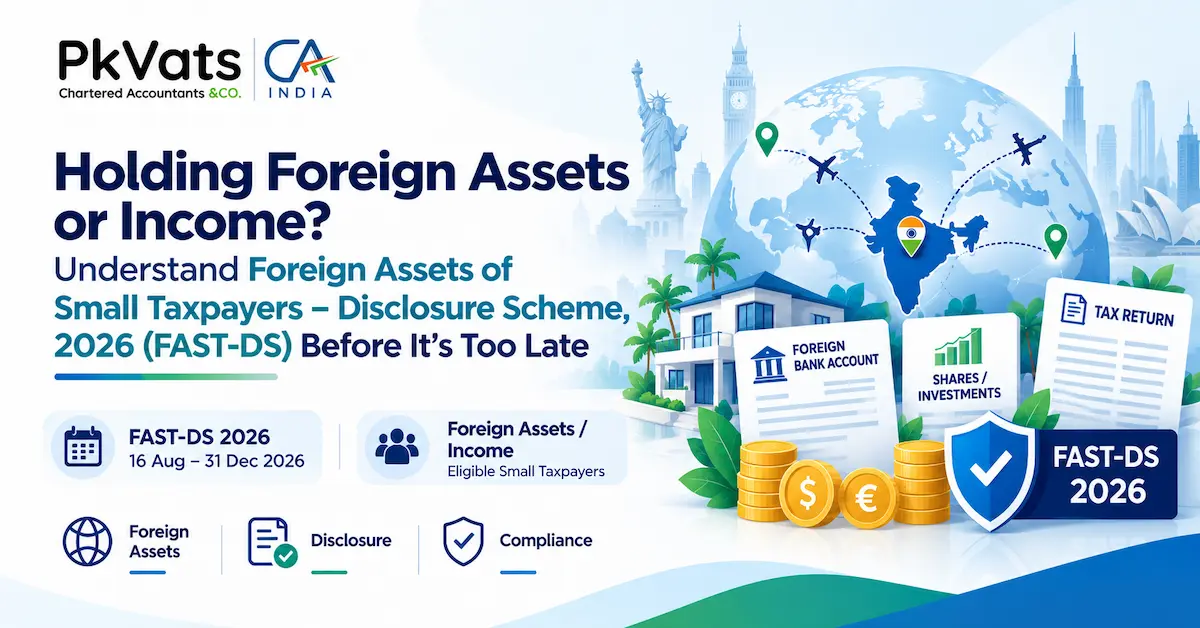
FAST-DS 2026 is a one-time chance to report overseas bank accounts, foreign stocks (like US shares or RSUs), foreign properties, or overseas income that were missed in ITR Filing. It provides eligible taxpayers an opportunity to declare undisclosed foreign assets, undisclosed foreign income and certain undeclared foreign assets, subject to the conditions of the Scheme.
Who it applies to: Anyone holding foreign assets or foreign income—whether you filed your ITR but forget to fill the schedule FA or missed filing ITR.
Why it matters: It allows you to fix past reporting mistakes legally, clear your record, and avoid heavy penalties under the Black Money Act.
NOTE: It is a time-bound window, so you must review and report your foreign holdings before the scheme closes.
Who Should Opt for FAST-DS?
The scheme is available to eligible taxpayers who satisfy the prescribed residential-status conditions.
Broadly, it applies to a person who:
- Was Resident in India in the relevant previous year; or
- Is currently Non-Resident (NR) or Resident but Not Ordinarily Resident (RNOR) but was Resident in India in the relevant previous year to which the undisclosed foreign income relates or in the year in which the foreign asset was acquired.
Key Triggers for Opting In
- Foreign Financial Assets Exceeding ₹20 Lakhs:
→ You hold overseas bank accounts, foreign shares, US RSUs/ESOPs, or mutual funds with an aggregate Fair Market Value exceeding ₹20 Lakhs, and omitted them in Schedule FA of your past ITRs.
→ Why Opt In? The ₹20 lakh threshold should not be treated as the FAST-DS eligibility limit; it is merely the threshold above which standard non-disclosure penalties normally apply.
- Foreign Immovable Property (Real Estate) of ANY Value:
→ You hold foreign land, residential flats, or commercial real estate outside India that was omitted from Schedule FA, regardless of whether it is worth ₹5 Lakhs or ₹2 Crores.
→ Why Opt In? The Black Money Act’s sub-₹20 lakh penalty waiver does NOT apply to real estate. Unreported foreign immovable property of any value carries severe penalty and prosecution risks, making FAST-DS essential.
→ You earned overseas salary, consulting fees, dividends, interest, or capital gains that were chargeable to tax in India but were never offered to tax.
→ Why Opt In? Declaring under Category 1 (60% Tax + Penalty) protects you from the 120% tax/penalty levy and potential criminal prosecution (3 to 10 years imprisonment) under the Black Money Act if detected later.
Who Should NOT Opt for FAST-DS 2026?
You should NOT opt for FAST-DS 2026 if you meet ALL of the following conditions:
Financial Assets Only: Your unreported holdings consist strictly of financial assets (shares, RSUs, bank balances, mutual funds) and contain NO foreign real estate or immovable property but, the total aggregate value of all your foreign financial assets is ₹20 Lakhs or less.
Legitimate, Tax-Paid Source and were Non Resident: The assets were acquired using income that was already offered to tax in India (e.g., taxed salary) or earned legally while you were a Non-Resident.
(Reasoning: For taxpayers meeting all three conditions, the flat ₹10 Lakh/year reporting penalty and prosecution provisions are statutorily waived under the Black Money Act. Therefore, paying the ₹1 Lakh Government fee under FAST-DS is unnecessary; you can simply begin disclosing the assets in your upcoming ITR).
What Can Be Disclosed?
A. Undisclosed foreign asset
This covers an asset located outside India where the source of investment has not been explained or the explanation is unsatisfactory, subject to the prescribed conditions.
Example: Foreign bank account, foreign shares/securities, foreign property, jewellery, etc., where the source of investment has not been satisfactorily explained.
B. Undisclosed foreign income
Foreign-source income that was chargeable to tax in India but was not offered to tax.
Example: Foreign interest, dividend, salary/business income, etc.
C. Foreign asset acquired while the taxpayer was Non-Resident
For example, a person earned income abroad while being a Non-Resident, acquired a foreign asset from that income, later became Resident in India, but did not disclose that foreign asset in the relevant ITR schedule.
Where the prescribed conditions are satisfied, this can fall under the ₹1 lakh fee category.
D. Foreign asset acquired from income already taxed in India
For example:
Indian income → already offered to tax in India → foreign shares purchased from that income → shares were not disclosed in ITR (Schedule FA).
These specified cases can fall under the separate ₹1 lakh fee category, subject to the conditions of the scheme.
What types of assets can be covered?
The Form 1 structure specifically provides for categories such as:
- 🏦 Foreign bank accounts
- 🏠 Foreign immovable property
- 💎 Jewellery
- 🎨 Artistic work
- 📈 Shares and securities
- 📦 Other foreign assets
- 💰 Foreign income
The Form 1 process also requires relevant details and, where applicable, supporting documents such as valuation reports and computation/value documents.
What Are the Benefits?
A valid declaration followed by the prescribed payment and certification provides specified immunity from further tax, penalty and prosecution under the Black Money Act, subject to the conditions of the Scheme.
The major benefit is regularisation of eligible past non-disclosures.
Normally, hiding foreign assets or forgetting to report them attracts severe penalties (up to ₹10 Lakh per year) and criminal prosecution under the strict Black Money Act, 2015. By using FAST-DS 2026, you get complete immunity from these harsh punishments, allowing you to fix past mistakes peacefully and legally.
In simple words:
Old foreign asset/income not disclosed → eligible declaration → prescribed payment → valid certification → specified immunity.
✅ Pros of Opting In By paying the prescribed tax/fee under FAST-DS, you get 100% statutory immunity from the harsh penalties. It buys you complete peace of mind.
What Happens If FAST-DS Is Not Considered?
Where a foreign asset or income remains undisclosed, the taxpayer may continue to face the applicable provisions of the Black Money Act, including tax, penalty and, where applicable, prosecution.
However, the consequences depend on the nature of the asset, its value, residential status, source of funds and other facts.
The 2026 amendments also introduced a ₹20 lakh threshold for certain foreign assets other than immovable property, subject to the statutory conditions. Therefore, the ₹10 lakh penalty and prosecution provisions should not be described as automatically applying to every small foreign asset.
❌ Cons of Not Opting In If you ignore this window and the Income Tax Department discovers your assets later, you will face severe consequences. For unexplained assets, this means a flat 120% tax/penalty on the asset’s value. For assets exceeding the ₹20 lakh threshold (or any foreign real estate), you also face severe prosecution and potential jail time under the Black Money Act.
Important documents/details to keep ready
Before filing Form 1, the taxpayer should collect:
- 📌 PAN details
- 📌 Passport details, where relevant
- 📌 Foreign bank account details
- 📌 Foreign broker/investment statements
- 📌 Foreign shares/securities details
- 📌 Foreign property details
- 📌 Date of acquisition
- 📌 Source of funds
- 📌 Fair Market Value
- 📌 Foreign income details
- 📌 Relevant ITRs
- 📌 Supporting valuation/computation documents
Important Valuation Rule: The valuation date for the scheme is strictly March 31, 2026. All fair market values must be calculated as of this exact date, using the specific valuation rules prescribed for each particular asset category (bank accounts, immovable property, shares, etc.).
The fair market value of your assets is calculated as of March 31st, 2026.
Summary:
FAST-DS 2026 is a golden, one-time, time-bound scheme that provides eligible taxpayers an opportunity to declare hidden or forgotten foreign assets and income. By making a valid declaration and paying the prescribed fee before the December 31, 2026 deadline, you can escape draconian penalties and secure statutory immunity from prosecution under the Black Money Act. Taxpayers with unreported foreign stocks, ESOPs, or bank accounts should review their past ITRs immediately to determine if this scheme applies to them.
Question & Answers
Q: If someone has reported their foreign assets in the ITR for FY 2025-26 but failed to declare those same assets in the ITR for FY 2024-25 (or earlier), do they still need to file under FAST-DS 2026?
Answer: Yes, absolutely. It is highly recommended to still file the FAST-DS 2026 declaration.
Here is exactly why correcting it in the current year doesn’t protect you for the past:
Penalties are Year-Specific: Under the Black Money Act (BMA), the legal obligation to report foreign assets in “Schedule FA” is an annual requirement. Missing the disclosure in FY 2024-25 is treated as an independent default for that specific year.
Past Mistakes Are Not Erased: Starting to report the asset in FY 2025-26 is a good corrective step, but it does not retroactively “cure” or erase the reporting failure for FY 2024-25.
The ₹10 Lakh Penalty Risk: The Income Tax Department can still scrutinize your past records and levy a flat penalty of ₹10 Lakh for failing to furnish the information in the FY 2024-25 return.
The FAST-DS Solution: Assuming the asset was originally bought with legitimate, tax-paid money (or NRI income) and its value is under ₹5 Crores, this scenario falls perfectly under Category 2 (Reporting Lapse). By paying the flat fee of ₹1 Lakh under FAST-DS, you permanently close the compliance gap for FY 2024-25 and buy complete immunity from the ₹10 Lakh penalty.
Q: If a taxpayer holds an undisclosed foreign asset (such as equity shares of a foreign company) that has generated zero income, are they still subject to tax and penalties?
Answer: Yes, absolutely. Under Indian tax law, you are still subject to severe penalties for holding an undisclosed foreign asset (like equity shares or RSUs), even if it generated zero income (no dividends, no capital gains).
Here is exactly how the law works and whether you need to file under the FAST-DS 2026 scheme.
Part 1: Why Are You Penalized for Zero Income?
Under the Black Money (Undisclosed Foreign Income and Assets) Act, 2015, all Resident Indians must declare every foreign asset in Schedule FA of their Income Tax Return (ITR).
The government penalizes the failure to report the overseas wealth, not just the income it yields. “Zero income” is not a valid legal defense. The penalties depend on how you bought those shares:
- If the source of funds is UNEXPLAINED (Undisclosed Asset):
If you cannot prove where the money came from to buy the shares, you will face a flat 30% tax + 90% penalty (Total 120%) on the current Fair Market Value of the shares, plus potential criminal prosecution. - If the source of funds is TAX-PAID (Reporting Default):
If you bought the shares using your legitimate, tax-paid Indian salary but simply forgot to declare them in Schedule FA, the law imposes a flat penalty of ₹10 Lakhs per financial year for the clerical failure to report them.
Part 2: Do You Need to File FAST-DS 2026?
Whether you should opt for the Foreign Assets of Small Taxpayers – Disclosure Scheme (FAST-DS) depends on the value of the shares and the source of your funds:
Scenario A: You bought the shares with legitimate, TAX-PAID income
- If the total value of your foreign shares is OVER ₹20 Lakhs:
YES, you must file FAST-DS. You fall under Category 2. By paying a flat, one-time government fee of ₹1 Lakh, you can permanently wipe out the ₹10 Lakh/year penalty risk and get full statutory immunity. - If the total value of your foreign shares is ₹20 LAKHS OR LESS:
NO, you do not need to file FAST-DS. Thanks to recent Budget 2026 amendments, the ₹10 Lakh penalty and criminal prosecution are statutorily waived for small foreign financial assets (like shares and bank accounts) under ₹20 Lakhs. You should skip the ₹1 Lakh scheme fee and simply start declaring these shares in Schedule FA of your next ITR. (Note: This waiver does not apply to foreign real estate).
Scenario B: You bought the shares with UNEXPLAINED / UNTAXED money
YES, you must file FAST-DS. If the value of the shares is up to ₹1 Crore, you fall under Category 1. You will have to pay 60% (30% tax + 30% penalty) of the asset’s value. While steep, it is much better than the 120% tax/penalty and jail time you will face if the Income Tax Department discovers the asset on their own.
Q: If someone held foreign shares or assets, failed to disclose them in Schedule FA, and has now sold them—do they still need to file under FAST-DS 2026?
Answer: YES, Absolutely. Selling or disposing of a foreign asset does NOT erase your past non-compliance. If you held foreign shares or assets in any past financial year while being an Indian Resident and omitted them from Schedule FA (Foreign Assets) of your Income Tax Return (ITR), you are still legally exposed under the Black Money Act, 2015.
Filing a declaration under FAST-DS 2026 is highly recommended to regularize those past years and secure complete statutory immunity.
Why Selling the Asset Does Not Protect You for Past Years
1. Penalties Under the Black Money Act Apply Year-by-Year
Under Section 43 of the Black Money Act (BMA), the obligation to disclose foreign assets in Schedule FA is an annual requirement. Missing the disclosure in a past ITR (e.g., FY 2022–23 or FY 2023–24) remains an independent, punishable default for that specific year—even if you no longer hold the asset today.
2. The Paper Trail Remains Intact
Selling an asset leaves a financial trail. The Income Tax Department tracks historical transactions through:
- Automatic Exchange of Information (AEOI) & Common Reporting Standard (CRS)
- Foreign broker purchase and sale statements
- Inward remittance records (LRS / bank statements)
- Annual Information Statement (AIS) / Taxpayer Information Summary (TIS)
Tax authorities can easily audit past records, verify the acquisition date, and establish that you held undisclosed foreign assets in earlier years.
3. Risk of Unreported Capital Gains & Foreign Income
If you sold the shares and earned a capital gain or received dividend income that was not offered to tax in India, you also have an undisclosed foreign income issue alongside the Schedule FA reporting default.
How FAST-DS 2026 Applies to Sold / Disposed Assets
The applicable treatment depends on how the foreign shares were originally acquired and how the sale proceeds were handled:
Scenario / Fact Pattern | FAST-DS Treatment | Payable Amount | Outcome & Immunity |
Scenario A: Tax-Paid Source (> ₹20 Lakhs Value)
Bought with legitimate, tax-paid Indian salary (or RSUs with TDS) or earned while an NRI. Shares were sold, but omitted from Schedule FA in past held years. | Category 2 (Reporting Lapse) | Flat Fee of ₹1,00,000 | Completely wipes out past ₹10 Lakh/year reporting penalties under Section 43 BMA for all years the asset was held. |
Scenario B: Undisclosed Source / Untaxed Sale Profits
Bought with unexplained money, OR capital gains/dividends from the sale were never offered to tax in India. | Category 1 (Undisclosed Asset / Income) | 60% Total (30% Tax + 30% Penalty on value/income up to ₹1 Cr) | Protects from draconian 120% tax/penalty and criminal prosecution under the Black Money Act. |
Scenario C: Financial Asset Value less than ₹20 Lakhs
Total aggregate value of foreign financial assets was less than ₹20 Lakhs and bought with tax-paid money. | BMA Statutory Waiver Applies | ₹0 Scheme Fee (FAST-DS not needed) | Penalty/prosecution for Schedule FA default is statutorily waived for financial assets less than ₹20L. (Note: Any untaxed capital gains from the sale must still be reported in current/revised ITR). |