
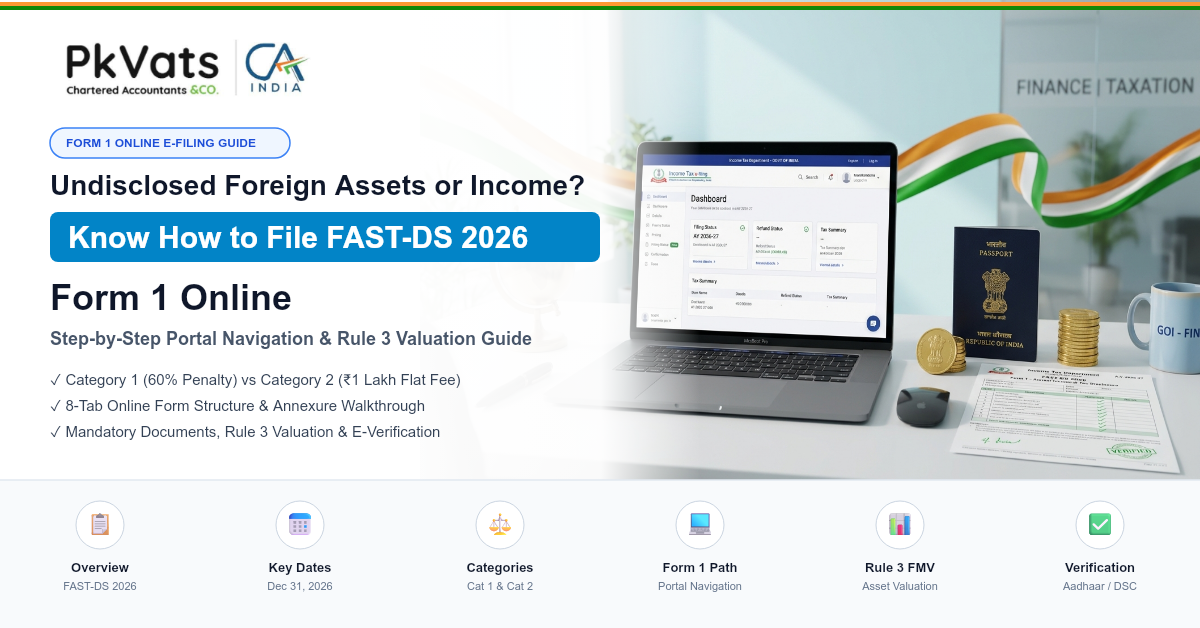
If you forgot to report foreign assets or overseas income in your tax returns, the Income Tax Department is offering a final chance to comply. Here is a comprehensive guide on understanding and filing Form 1 under the FAST-DS scheme.
Overview: What is FAST-DS?
The Foreign Assets of Small Taxpayers Disclosure Scheme, 2026 (FAST-DS) is a one-time voluntary disclosure scheme under Chapter IV of the Finance Act, 2026. It allows eligible taxpayers to disclose previously unreported foreign assets and income.
Important Dates to Remember:
• Commencement: 16 August 2026
• Valuation Date: 31 March 2026 (FMV)
• Filing Deadline: 31 December 2026 (Form 1)
Categories & Amount Payable:
The scheme divides non-disclosures into two distinct categories based on the source of funds:
• Category 1 (Wholly Undisclosed Assets/Income): For assets up to ₹1 crore bought with income never taxed in India. You Pay: A 60% penalty on the total asset value.
• Category 2 (Undeclared but Explained Assets): For assets up to ₹5 crore bought with taxed income (or NRI income) that you simply forgot to report in your ITR. You Pay: A flat fee of ₹1 lakh.
Step-by-Step Process to File FAST-DS Form 1
Step 1: Log in to the Income Tax e-Filing Portal. Visit the official Income Tax e-Filing Portal:
https://eportal.incometax.gov.in/iec/foservices/#/login
Log in using the taxpayer’s PAN and password.
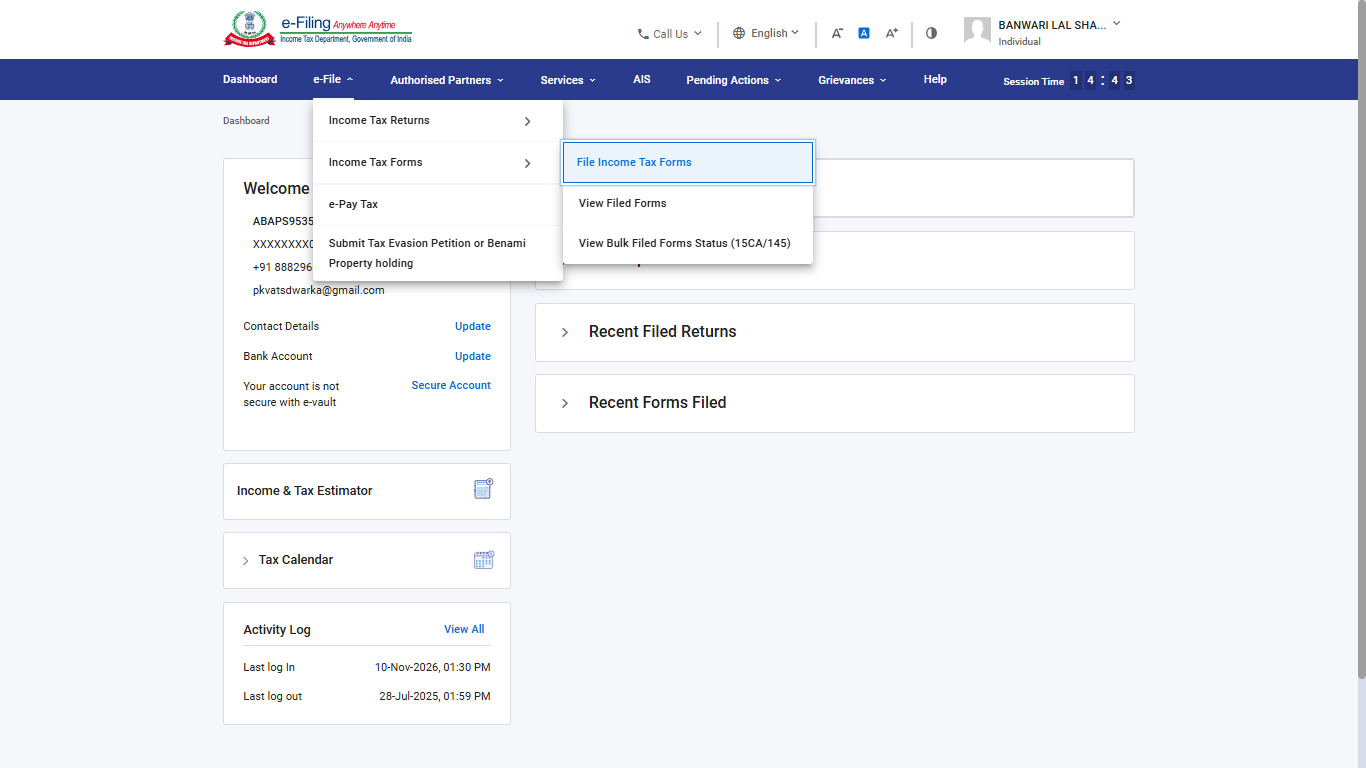
Step 2: Navigate to Form 1. After logging in, follow this path:
e-File → Income Tax Forms → File Income Tax Forms
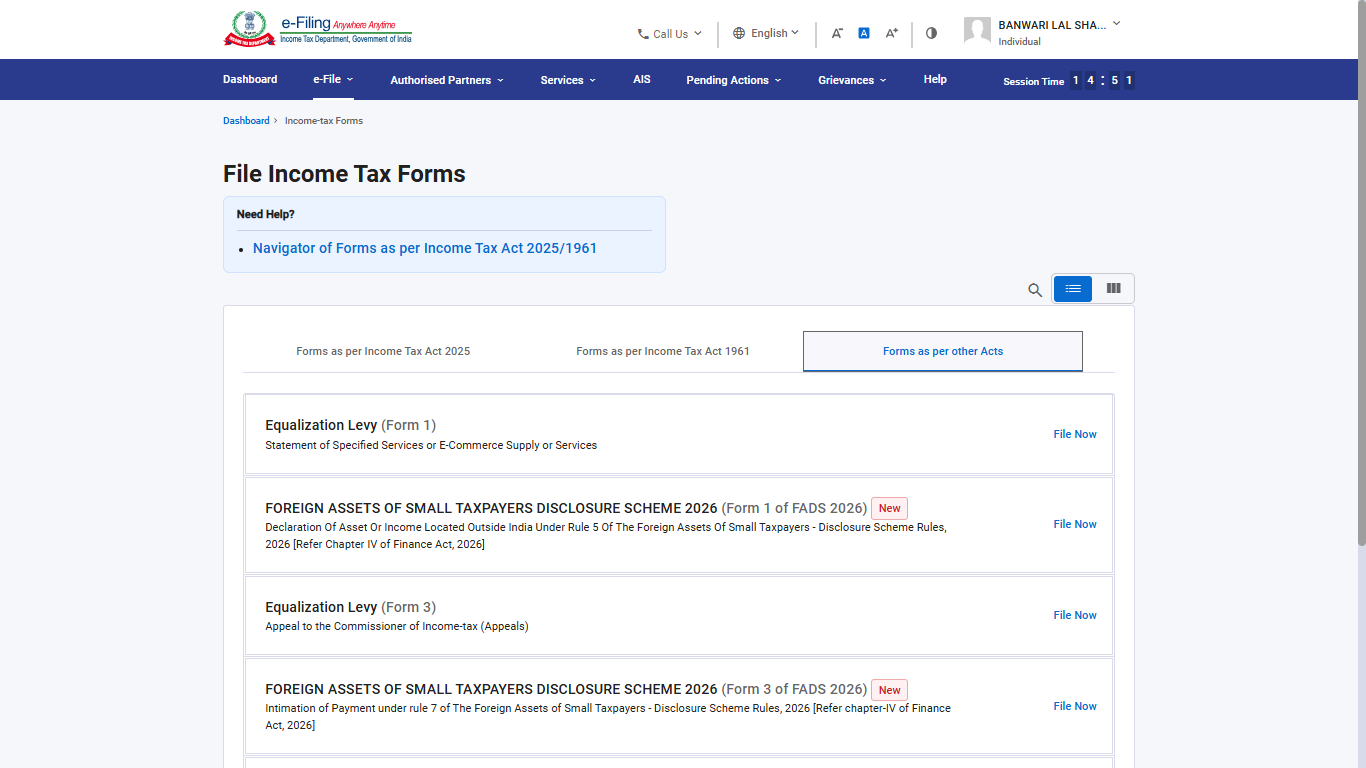
Under the section Forms as per Other Acts, search for:
FOREIGN ASSETS OF SMALL TAXPAYERS’ DISCLOSURE SCHEME, 2026 (Form 1 of FADS 2026).
Click on File Now.
Step 3: Start the Form 1 Filing Process. On the form landing page, the following details will generally be displayed:
PAN
Submission Mode – Online
Filing Type – Original
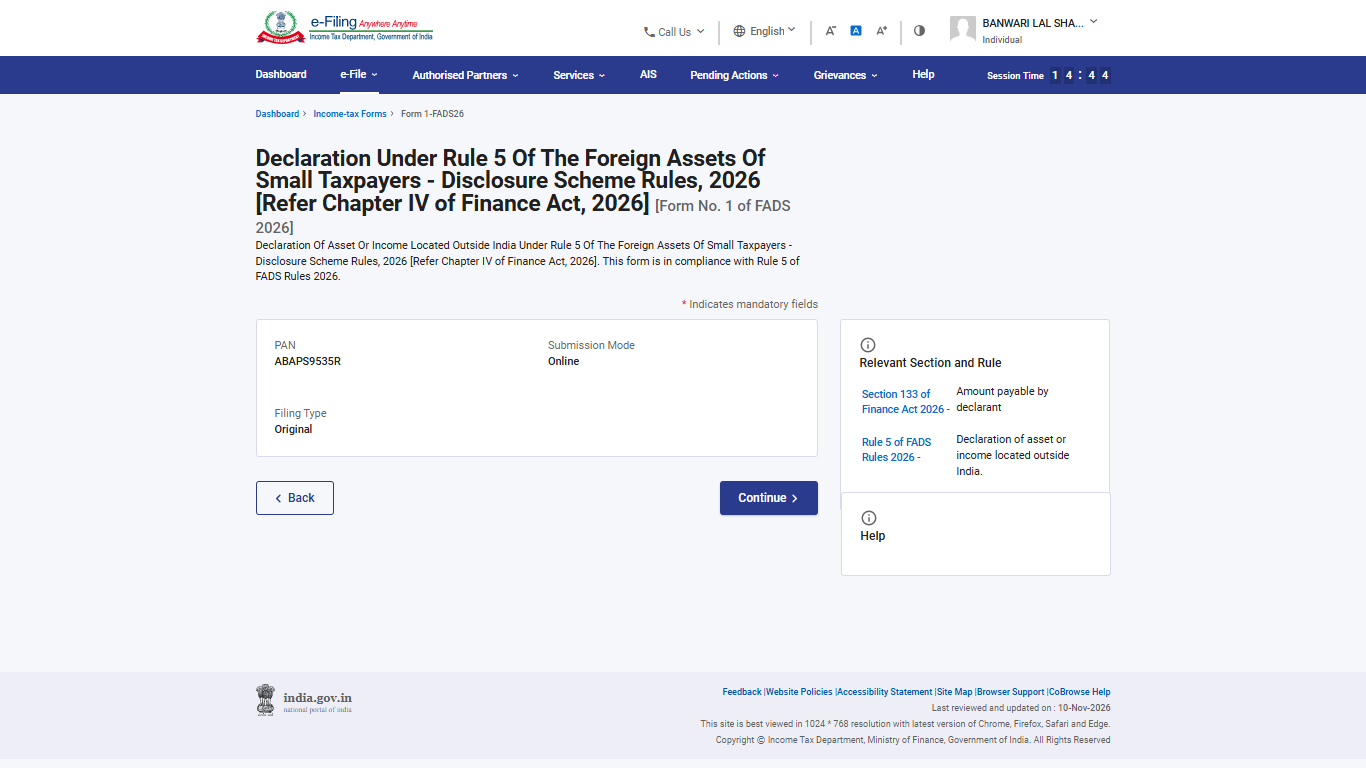
Check the details and click Continue.
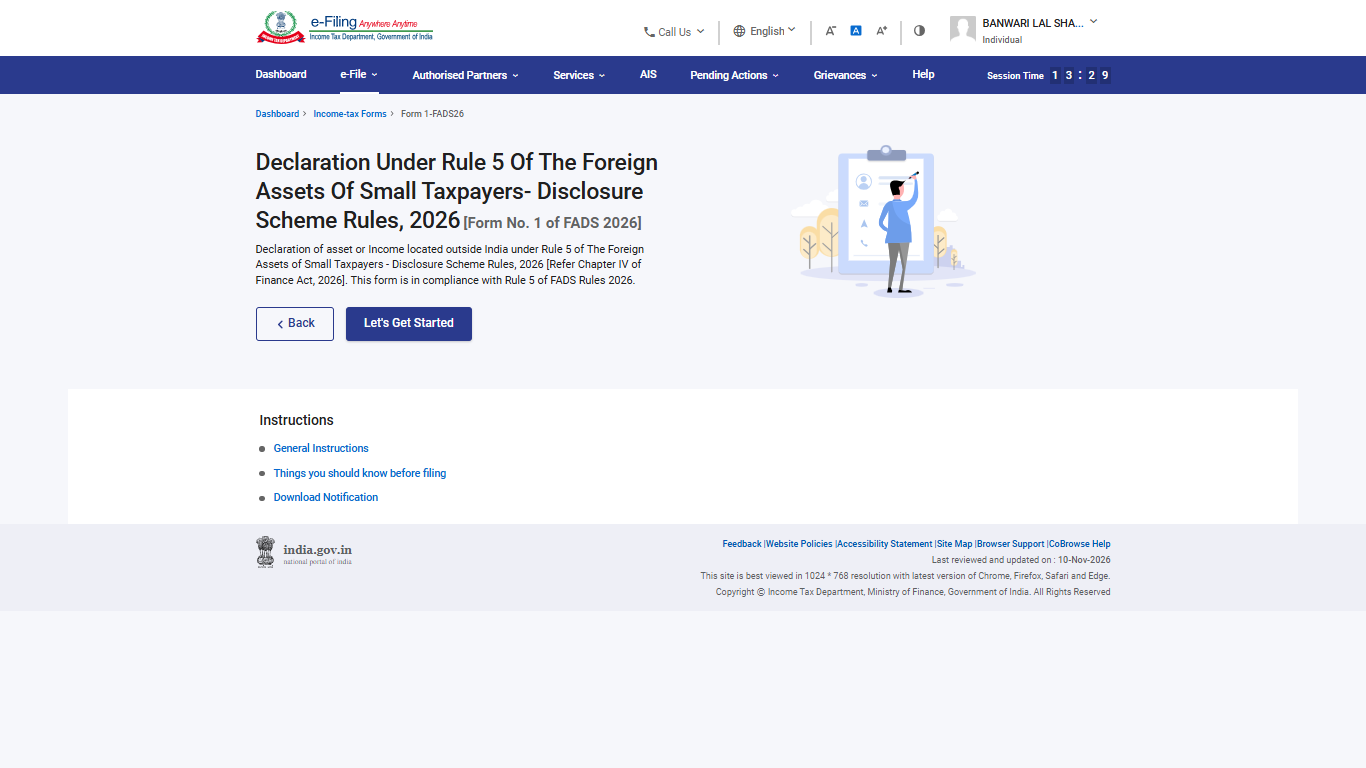
After that, click Let’s Get Started to open the Form 1 filing sections.
The form contains eight tabs:
1. Part A – Basic Information
2. Part B – Details of Asset or Income
3. Annexure to Undisclosed Asset Located Outside India
4. Annexure to Undisclosed Foreign Income
5. Annexure for Assets Acquired from Foreign Income During Non-Resident Status
6. Annexure for Assets Acquired from Income Already Offered to Tax in India
7. Part C & D – Categorised Summary of Foreign Assets, Income for Valuation and Amount Payable
8. Verification
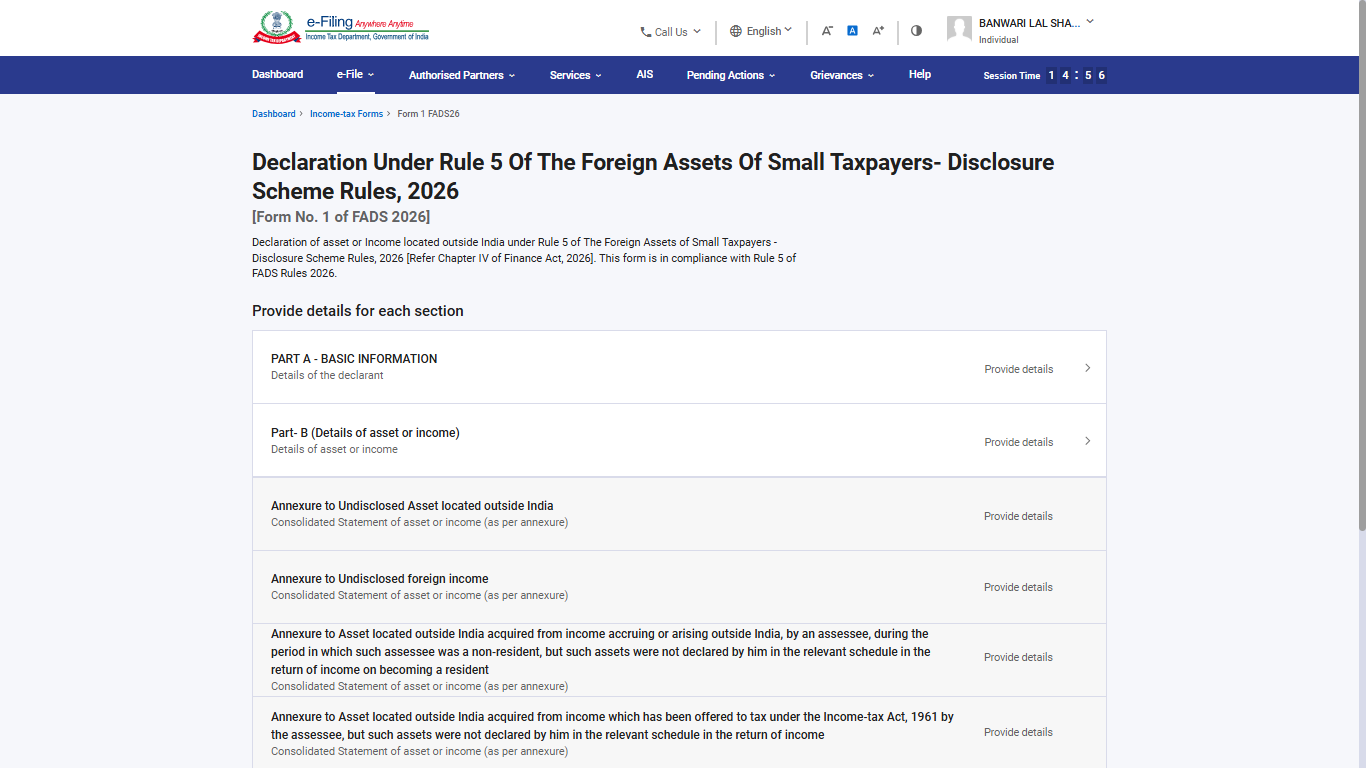
Let’s understand each section One by One.
How to Fill Part A – Basic Information
Part A contains the basic details of the declarant.
The following information is required:
• First Name
• Middle Name
• Last Name
• Address
• PAN
• Passport Number (optional)
• Passport document attachment (optional)
Check the name, address and PAN carefully. Most basic information is generally auto-populated from the taxpayer’s profile.
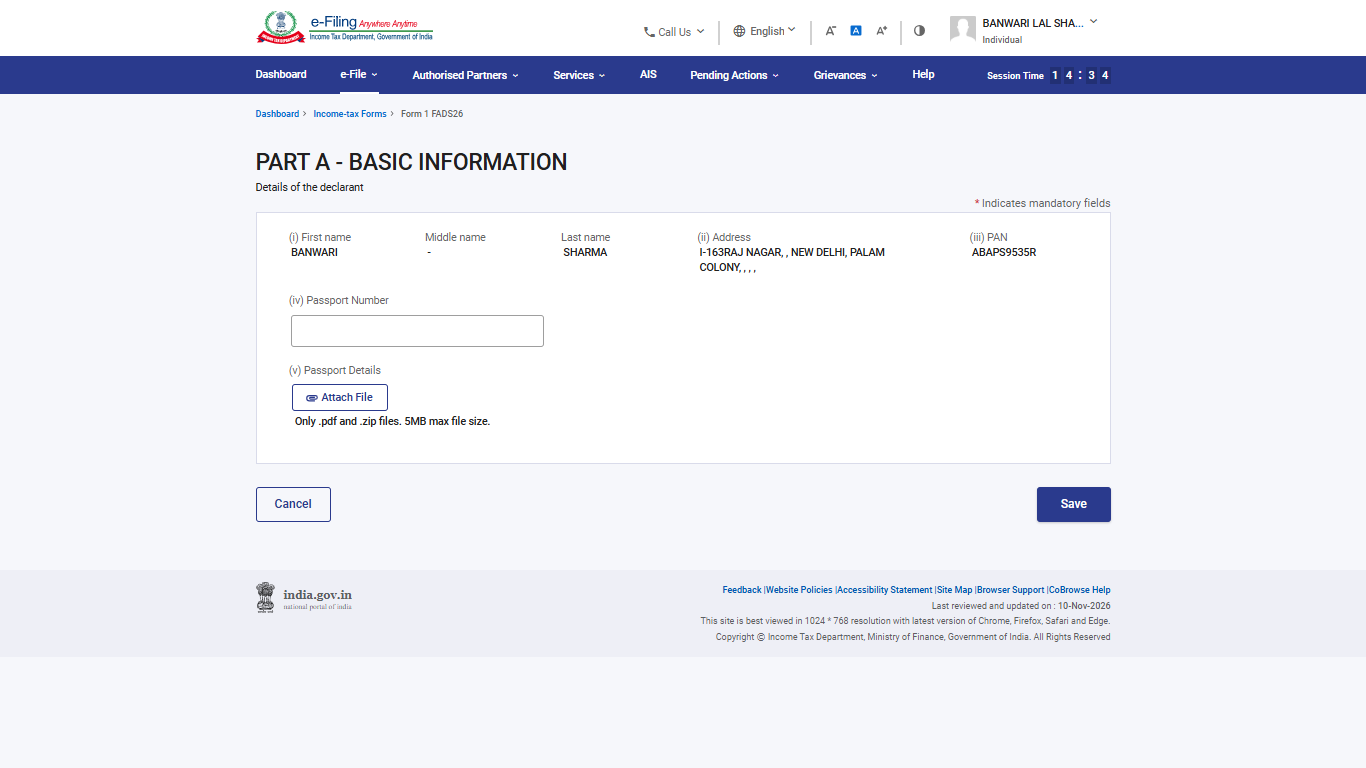
If the assessee does not have a passport, there is no need to fill in any passport-related details.
Note: If the declarant does not have a passport, do not enter an incorrect or fictitious passport number. The official user manual identifies passport details as optional.
After checking the information, click Save.
How to Fill Part B – Details of Asset or Income
Part B is an important section because the taxpayer must identify the nature of the disclosure. The declarant needs to select the applicable asset or income category based on the actual facts of the case.
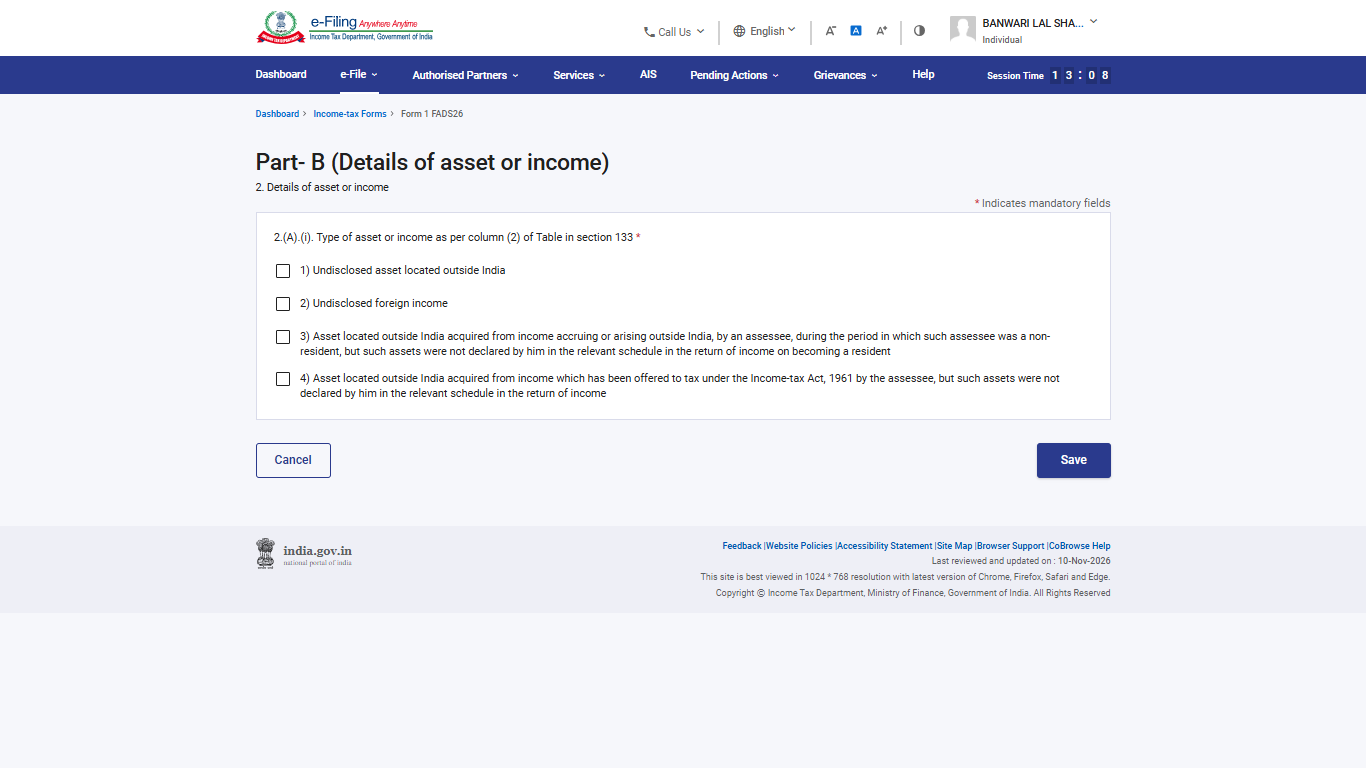
Option 1 & 2 Lies in Category I and Option 3 & 4 Lies in Category II > Select option as per assessee Case.
The form permits multiple asset and income selections where applicable.
Important: Do not select an income or asset category merely because it appears suitable in the dropdown. The selection should match the actual nature of the foreign asset or income and the relevant provisions of the scheme.
How to Fill Annexure for Assets Acquired from Income Already Offered to Tax in India
This annexure applies where a foreign asset was acquired from income already offered to tax under the Income-tax Act, 1961, but the asset was not disclosed in the relevant schedule of the Income Tax Return.
For example, a taxpayer purchased foreign shares using salary income that was already offered to tax in India but did not report those shares in Schedule FA.
The relevant asset details and supporting information should be entered in this annexure.
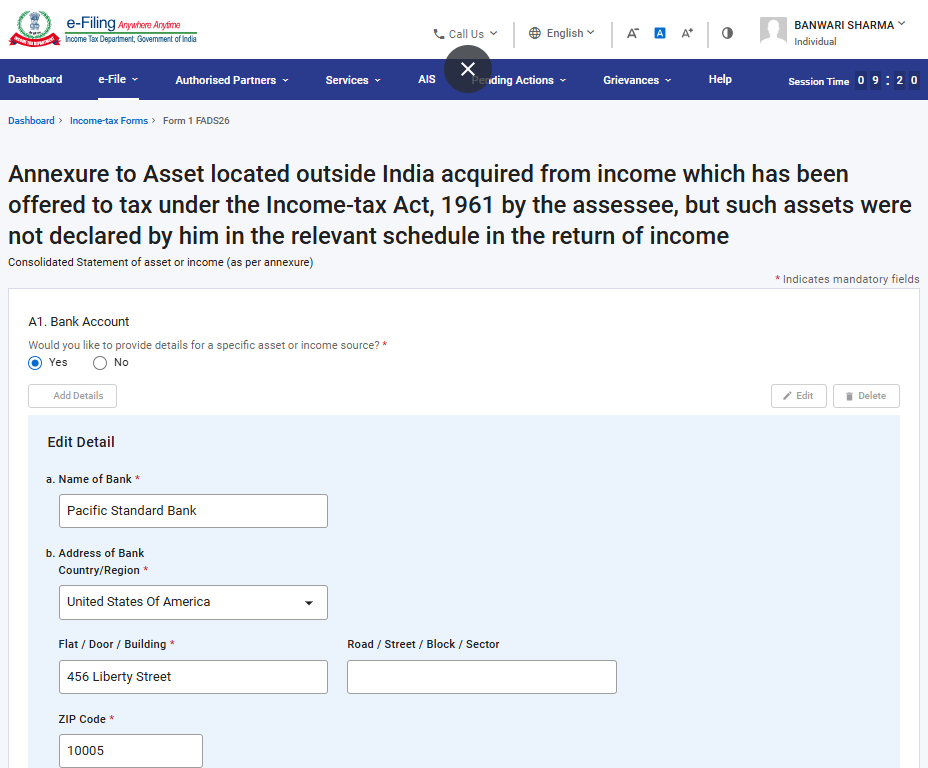
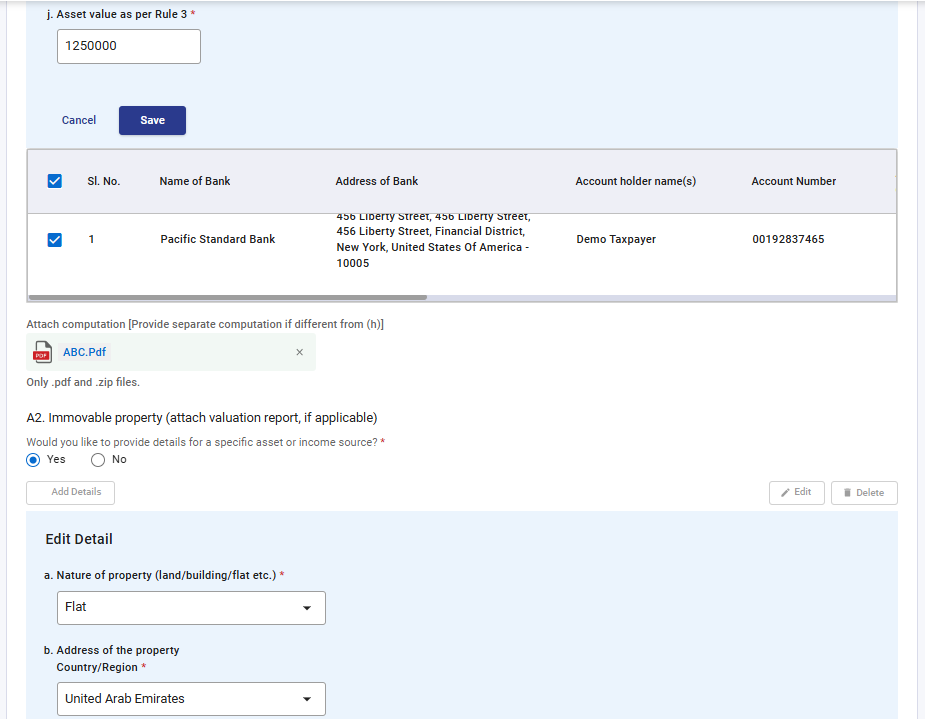
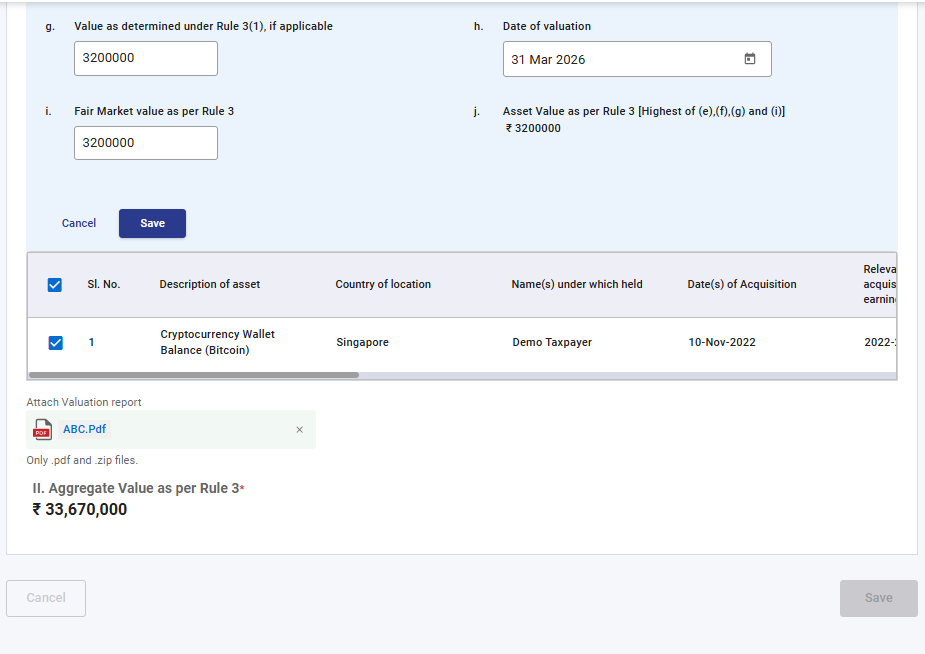
For example, if you have a Foreign Bank Account, select yes against the Bank Account option and click on Add Details. Enter all the required information related to the bank account and click on Add to save the details. Similarly, if you have more than one foreign bank account, click on Add Details again after adding the first bank account. Enter the details of your second bank account and click on Add. Follow the same process to add all your foreign bank accounts.
Once all the bank accounts have been added, a table will appear below the Add Details option. You can scroll through this table and cross-check all the details entered. If you notice any mistake, you can easily correct it.
To edit the details, select the checkbox in the first column of the table. The Edit and Delete options will become active on the right-hand side. Click on Edit to make the necessary corrections. After making the changes, click on Add at the end of the details section to save the corrected information.
You also need to upload the relevant supporting documents in PDF or ZIP format as required by the form.
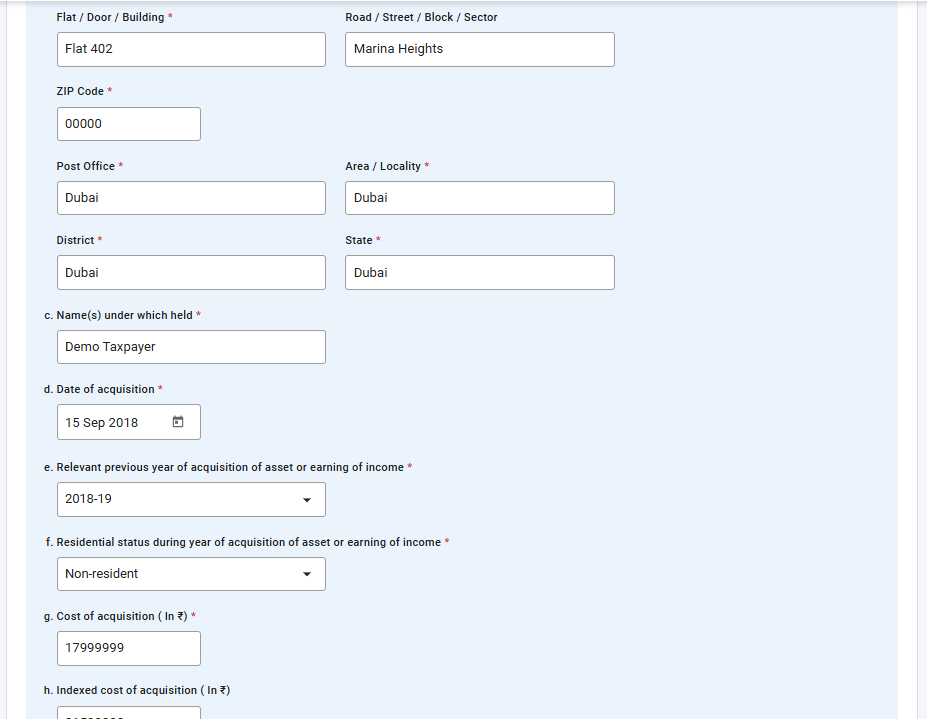
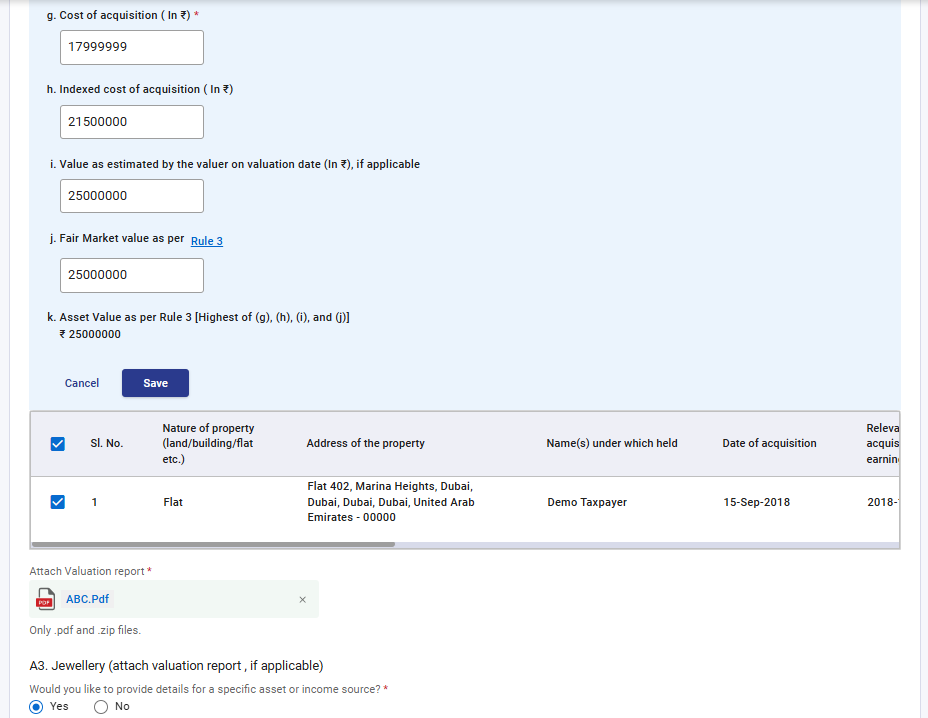
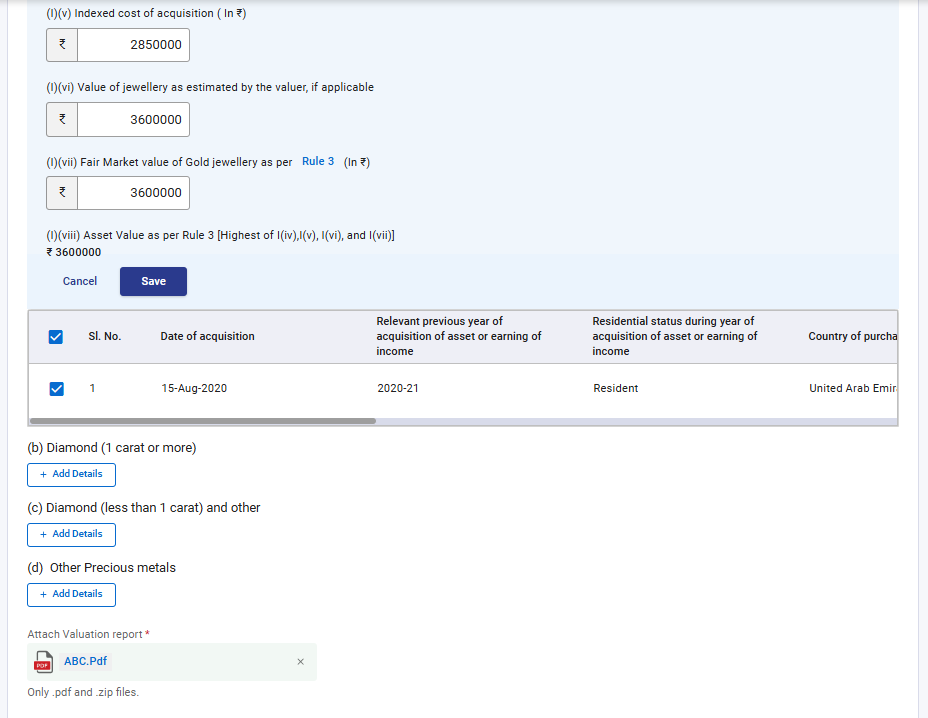
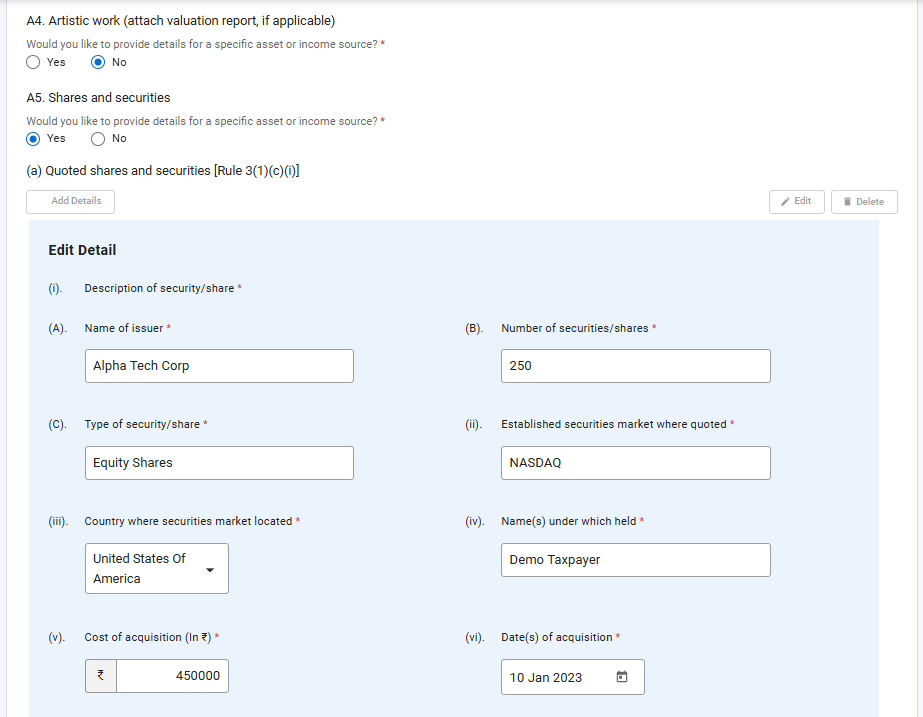
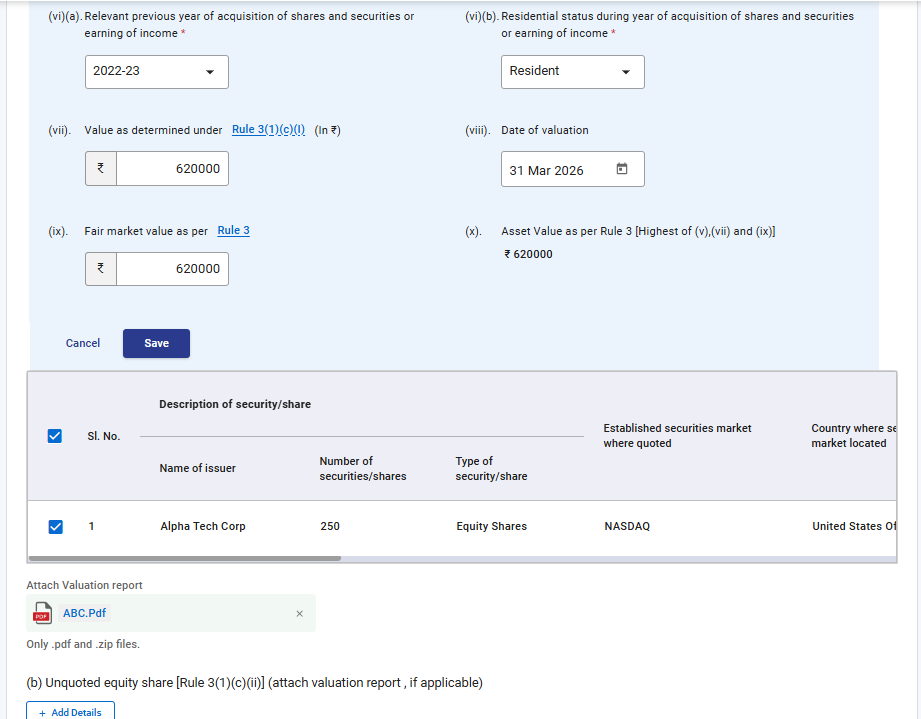
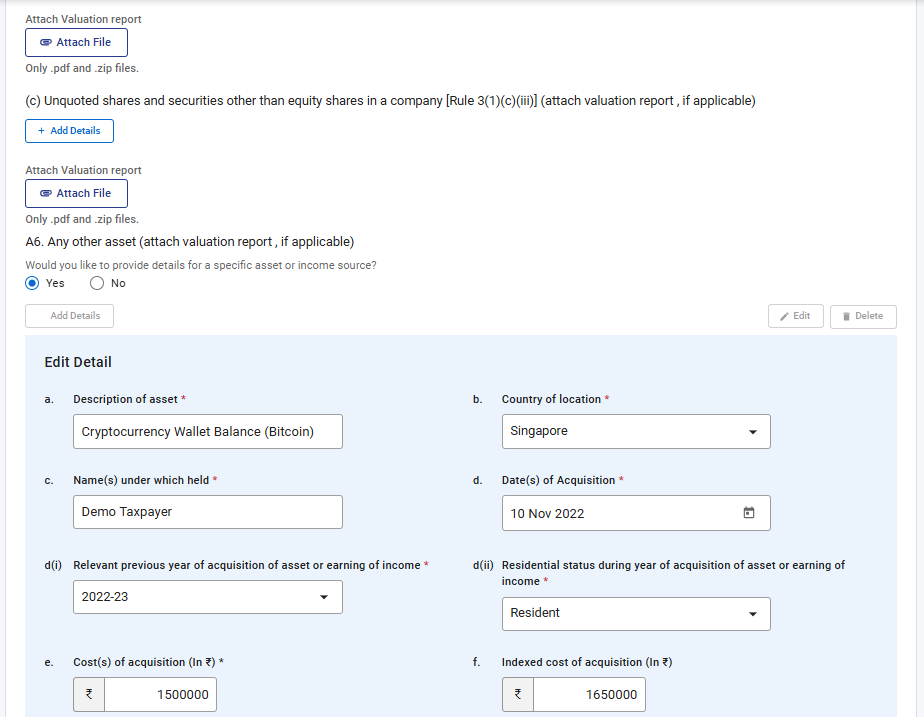
Similarly, go through the other categories like A2. Immovable Property, A3. Jewellery (Gold, Diamond, or other precious stones), A4. Artistic Work, A5. Shares & Securities (Quoted shares, Unquoted equity shares, and other Unquoted securities), and A6. Any Other Assets. Select ‘Yes’ only for the assets you actually own, fill in the requested details, and select ‘No’ for the rest. You do not need to fill in anything for the options you mark as ‘No’.
At the very end of the form, you will see the ‘Aggregate value of asset as per Rule 3’. This shows the total taxable amount on which your final tax will be calculated. You can manually match your own total asset value with this automatically calculated taxable amount to ensure everything is correct.
After checking the information, click Save.
• What is asset valuation as per rule 3?
Under the FAST-DS 2026 scheme, Rule 3 outlines the rules that determine the final ‘Asset Value’ for different foreign assets on which tax will be calculated.
The Income Tax Department has set different valuation criteria for each type of asset under this scheme. Rule 3 ensures that the tax is calculated on the highest possible value of the asset.
Here is how asset valuation is done as per Rule 3 for each category:
1. Bank Account (A1)
For a bank account, Rule 3 states that the asset value will be either the sum of all credits or the Fair Market Value (FMV), whichever is higher.
This means that all the money deposited into the account from the date it was opened up to the valuation date (31 March 2026) is totaled up (without subtracting any withdrawals).
2. Immovable Property (A2) & Artistic Work (A4)
For property or artistic work, Rule 3 states that the asset value will be considered as the highest of these four amounts:
• Cost of acquisition: The original price at which it was bought.
• Indexed cost of acquisition: The purchase price adjusted for inflation up to today’s date.
• Value estimated by valuer: The estimated value provided by a registered valuer.
• Fair Market Value (FMV): Its actual current price in the open market.
3. Jewellery (A3)
For jewellery (gold, diamonds, precious metals), Rule 3 also states that the highest value among these four will be taken:
• Cost of acquisition: The actual purchase price.
• Indexed cost of acquisition: The inflation-adjusted price.
• Value estimated by valuer: The estimate given by a jeweller or valuer.
• Fair Market Value (FMV): Today’s market price (calculated per gram or carat).
4. Shares and Securities (A5)
For shares, the valuation rules depend on their specific type:
● Quoted Shares: Under Rule 3(1)(c)(i), the value will be the highest of these three:
• Cost of acquisition
• Value determined under Rule 3(1)(c)(i) (The market price on the valuation date)
• Fair Market Value (FMV)
● Unquoted Shares: Under Rule 3(1)(c)(ii) & (iii), the value will be the highest of these four:
• Cost of acquisition
• Indexed cost of acquisition
• Value determined under Rule 3(1)(c)(ii)/(iii) (Based on the book value of assets and liabilities)
• Fair Market Value (FMV)
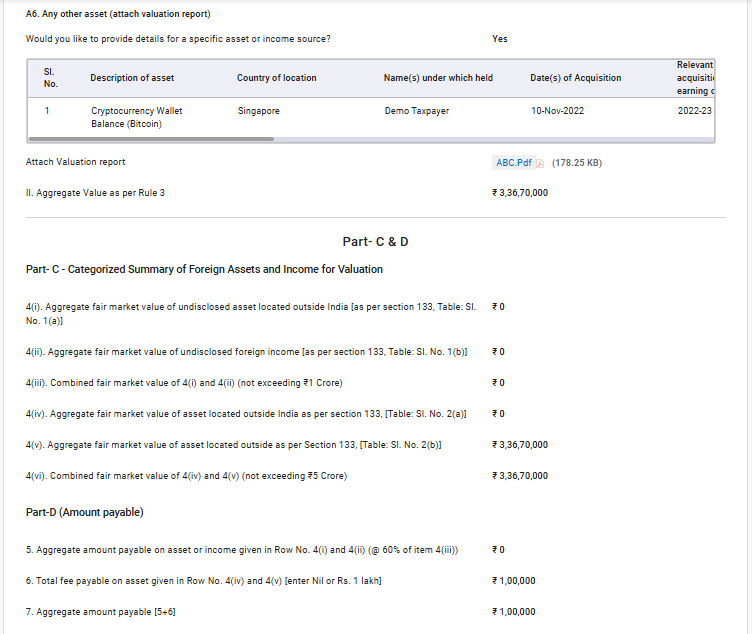
5. Any Other Asset (A6) (e.g., Crypto)
For any other asset, Rule 3 states that the asset value will be the highest of these four:
● Cost of acquisition
● Indexed cost of acquisition
● Value determined under Rule 3(1) (A custom valuation rule, if applicable)
● Fair Market Value (FMV)
Keep in Mind: The basic concept of Rule 3 is that the Income Tax Department calculates tax based on the maximum possible amount for any asset—whether that is the original purchase price, the inflation-adjusted price, or today’s market value. This is why the highest amount is always auto-selected during the ‘Asset Value as per Rule 3’ calculation on the form.
Part C & D – Summary of Foreign Assets, Income and Amount Payable
After completing the applicable annexures, review Part C and Part D.
This section ensures your Aggregate Fair Market Value (FMV) of Category 1 assets complies with the ₹1 crore limit and Category 2 assets comply with the ₹5 crore limit. Verify the auto-calculated figures in Part C.
Review Part D, which displays your final auto-computed tax liability—either 60% of the declared amount (Category 1) or the ₹1,00,000 flat fee (Category 2). Once verified, save and submit your form electronically.
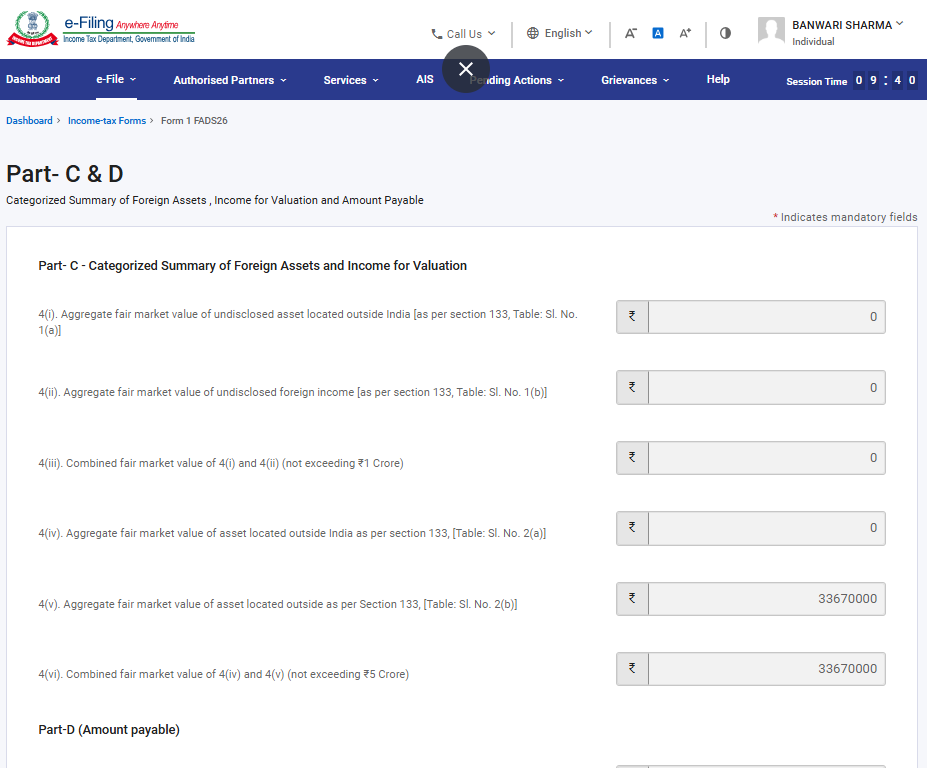
The amount displayed should be reviewed carefully before proceeding. After checking the information, click Save.
Verification and Submission of Form 1
The final tab is Verification.
First, you need to open the “Verification” tab within the form.
In this section, you must confirm your name and PAN.
Then, enter the place of declaration.
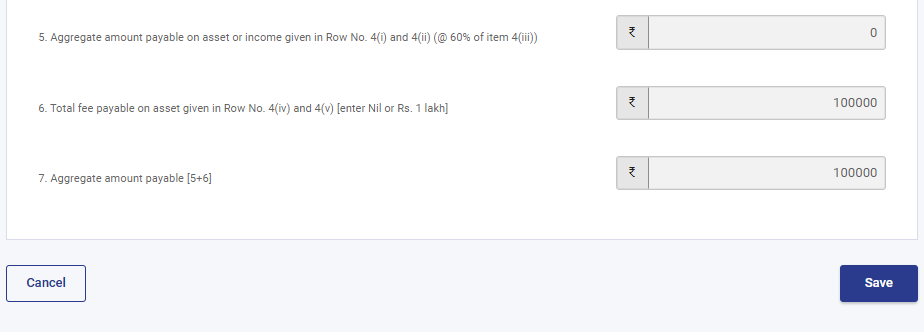
Finally, click “Save” to complete this step.
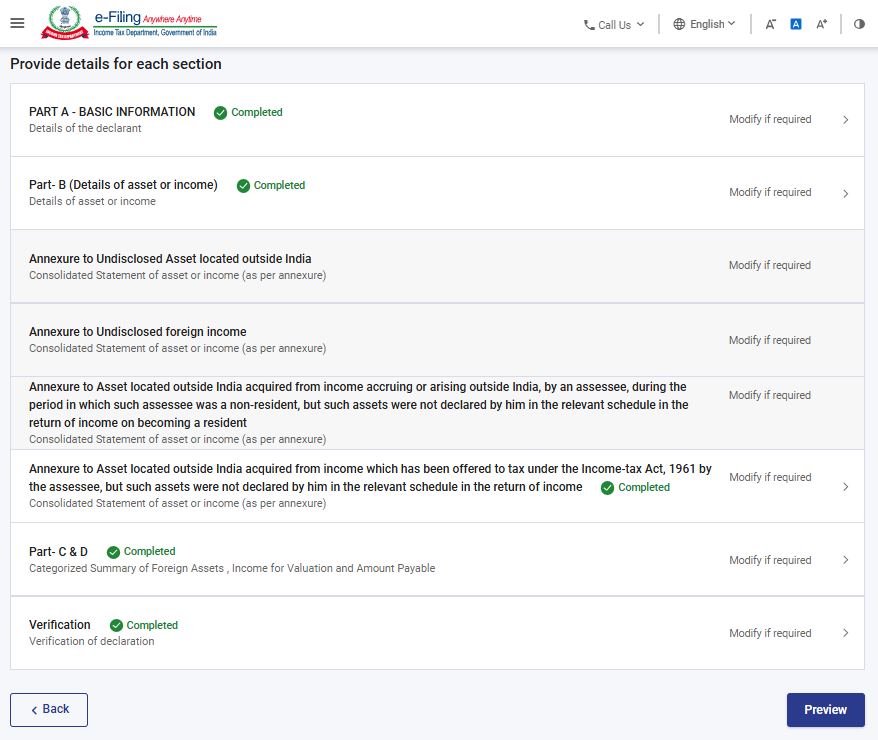
The form contains eight tabs:
1. Part A – Basic Information
2. Part B – Details of Asset or Income
3. Annexure to Undisclosed Asset Located Outside India
4. Annexure to Undisclosed Foreign Income
5. Annexure for Assets Acquired from Foreign Income During Non-Resident Status
6. Annexure for Assets Acquired from Income Already Offered to Tax in India
7. Part C & D – Categorised Summary of Foreign Assets, Income for Valuation and Amount Payable
8. Verification
Once every mandatory tab displays a green “Completed” checkmark, the “Preview” button becomes active. Click “Preview” to check your declaration
Before submitting the form, verify that:
• The declarant’s PAN and personal details are correct.
• The correct disclosure category has been selected.
• All relevant foreign assets and income have been included.
• The valuation has been calculated according to Rule 3.
• Supporting documents and valuation reports, wherever applicable, have been attached.
• The information provided is complete and accurate.
After checking all details, complete the required e-verification through an available permitted method, such as Aadhaar OTP, DSC or eligible EVC.
Submit Form 1 and download or save the acknowledgement for future reference.
Conclusion: File Carefully to Stay Compliant
Filing Form 1 under the FAST-DS 2026 scheme is a final opportunity to declare undisclosed foreign assets and overseas income.
Since Form 1 requires a significant amount of detailed information, you must carefully handle technical details like the strict Valuation Date (31st March 2026), Rule 3 computations, valuation reports, and foreign currency conversions. Because the form cannot be revised once submitted, accuracy is critical to ensure no mistakes are made.
It is highly recommended to seek help from a tax expert.