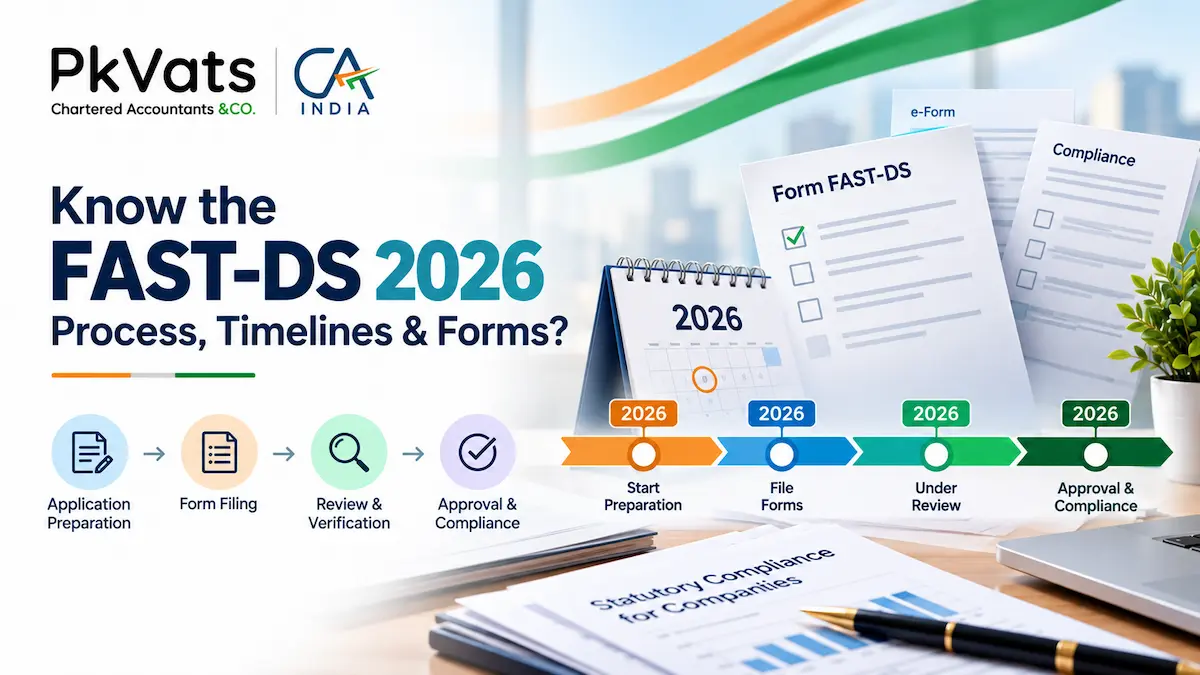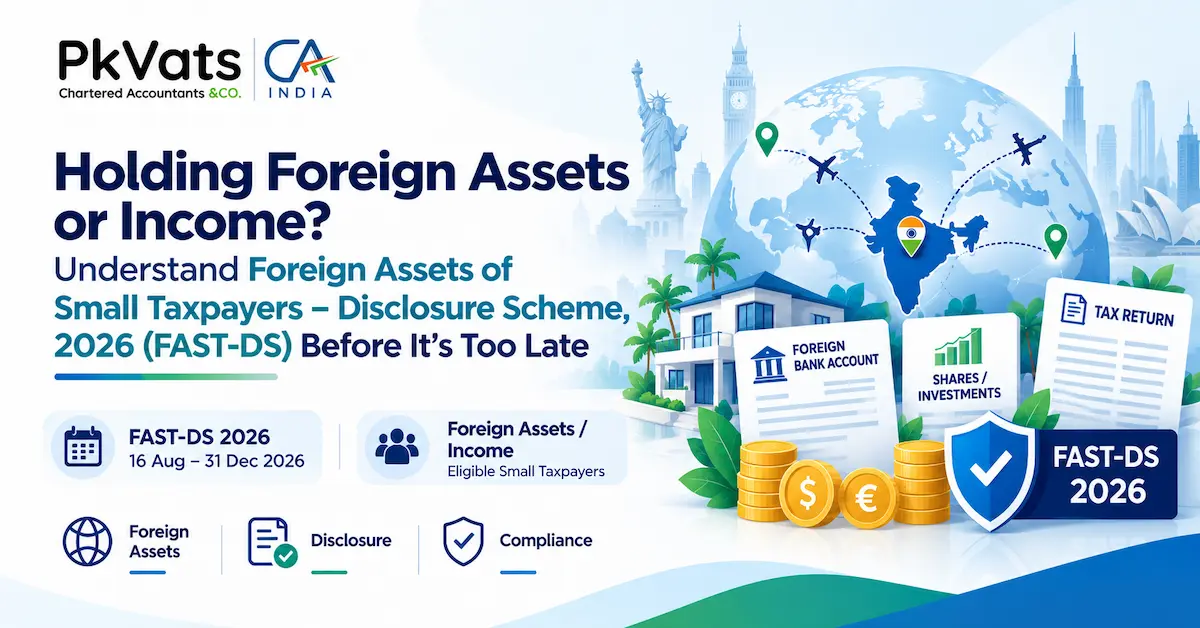

 FAST-DS 2026 – Points Covered
- Overview
- Category 1: Undisclosed Assets & Untaxed Foreign Income
- 2.1. Key Eligibility Parameters
- 2.2. Examples for Category 1
- Category 2: Specified Eligible Foreign Assets (Reporting Lapses)
- 3.1. Key Eligibility Parameters
- 3.2. Examples for Category 2
- Comparison Matrix: Category 1 vs. Category 2
- Crucial Rule to Remember
- Summary
- More Examples
Overview
Understanding the distinction between Category 1 and Category 2 under the Foreign Assets of Small Taxpayers – Disclosure Scheme, 2026 (FAST-DS) is the most critical step in evaluating a client’s liability.
The scheme does not apply a uniform 60% penalty across all foreign assets. Instead, it classifies disclosures into two distinct legal buckets based on the nature of the undisclosed asset, origin of the funds, residential history, and the nature of the compliance lapse.
Category 1: Undisclosed Assets & Untaxed Foreign Income
Category 1 applies to cases involving an undisclosed foreign asset for which the source of investment is unexplained or the explanation is unsatisfactory, or foreign income that was chargeable to tax in India but was not offered to tax.
2.1. Key Eligibility Parameters
- Nature of Default: Asset purchased with money that was never offered to tax in India, or foreign income earned that escaped Indian tax liability.
- Monetary Ceiling: Applicable where the aggregate value of the undisclosed foreign asset or foreign income does not exceed ₹1 Crore.
- Amount Payable: 60% of the undisclosed foreign asset or income (30% Tax + 30% Penalty under the scheme).
- Primary Statutory Objective: Regularizing undisclosed wealth to avoid the normal 120% tax/penalty exposure under the Black Money Act, 2015 and the applicable prosecution provisions.
2.2. Examples for Category 1
Example A: Undisclosed Foreign Bank Account (Offshore Consulting Income)
- Background: Mr. Vikram, a resident IT consultant in Mumbai, provided remote advisory services to an offshore client in FY 2023–24. He received $45,000 (approx. ₹38 Lakhs) directly into a Singapore bank account. He never reported this income in his Indian ITR nor disclosed the bank account in Schedule FA.
- Analysis: Because the underlying income was never offered to tax in India, the bank balance constitutes undisclosed foreign income and an undisclosed foreign asset. The total value (₹38 Lakhs) is within the ₹1 Crore threshold for Category 1.
- FAST-DS Calculation:
Payable Amount= ₹38,00,000 × 60% = ₹22,80,000 (30% Tax + 30% Penalty)
- Outcome: Upon paying ₹22.8 Lakhs, Mr. Vikram receives complete statutory immunity from the 120% Black Money Act tax/penalty and criminal prosecution.
Example B: Foreign Equity Shares Purchased from Unexplained Cash
- Background: Mrs. Ananya transferred funds through non-bank/unexplained channels in 2022 to purchase US technology stocks valued at ₹70 Lakhs as of March 31, 2026. She cannot satisfactorily substantiate the source of the initial investment funds to the tax department.
- Analysis: Since the source of investment cannot be explained with tax-paid funds, the shares fall under Category 1. The total value (₹70 Lakhs) is below the ₹1 Crore cap.
- FAST-DS Calculation:
Payable Amount = ₹70,00,000 × 60% = ₹42,00,000
- Outcome: Mrs. Ananya regularizes the shares by paying ₹42 Lakhs, avoiding asset seizure and prosecution.
Category 2: Specified Eligible Foreign Assets (Reporting Lapses)
Category 2 is a concessional relief window designed for taxpayers who committed a pure reporting default (omitting the asset in Schedule FA) despite the underlying investment funds being fully legitimate and tax-paid.
3.1. Key Eligibility Parameters
- Nature of Default: The foreign asset was acquired out of:
- Income already offered to tax in India (e.g., salary, RSUs with TDS, taxed business profits);
OR
- Foreign-sourced income earned while the taxpayer was a Non-Resident (NR), which was not declared after returning to India and becoming a Resident.
- Monetary Ceiling: Applicable where the aggregate value of specified foreign assets does not exceed ₹5 Crores.
- Statutory Rate: A fixed fee of ₹1,00,000, regardless of whether the asset is worth ₹15 Lakhs, ₹1 Crore, or ₹4.8 Crores.
- Primary Statutory Objective: Wiping out the flat ₹10 Lakh/year reporting penalty under Section 43 of the Black Money Act for missing Schedule FA disclosures.
3.2. Examples for Category 2
Example 2A: Tech Employee with Foreign RSUs (Tax Deducted at Source)
- Background: Rahul works for a US multinational in Bengaluru. Between 2021 and 2025, he received Restricted Stock Units (RSUs) worth ₹2.5 Crores. His employer deducted full perquisite tax (TDS under Section 192) at the time of vesting. However, Rahul failed to disclose these holdings in Schedule FA in his past 4 ITR filings.
- Analysis: The source of funds is fully explained and already taxed in India. The default is
strictly a reporting omission in Schedule FA. The total portfolio value (₹2.5 Crores) is within the ₹5 Crore Category 2 ceiling.
- FAST-DS Calculation:
Payable Amount = Fixed Fee of ₹1,00,000
- Outcome: Instead of facing potential cumulative penalties of ₹40 Lakhs (₹10 Lakhs × 4 years under Section 43 of BMA), Rahul pays a flat fee of ₹1 Lakh to secure full immunity for all past years.
Example 2B: Returning NRI with Overseas Savings & Bank Deposits
- Background: Priya worked in London for 8 years as a Non-Resident. She accumulated savings and maintained a UK bank deposit worth ₹4 Crores. She returned to India in 2022 and became a Resident taxpayer, but forgot to disclose her UK account in Schedule FA.
- Analysis: The foreign asset was acquired out of foreign income earned while Priya was a Non-Resident. Since the asset value (₹4 Crores) is under the ₹5 Crore limit, it qualifies under Category 2.
- FAST-DS Calculation:
Payable Amount = Fixed Fee of ₹1,00,000
- Outcome: Priya regularizes her entire overseas bank account by paying a flat ₹1 Lakh fee, permanently closing her past compliance exposure.
Comparison Matrix: Category 1 vs. Category 2
| Feature | Category 1 (Undisclosed Sources) | Category 2 (Reporting Lapses) |
| Source of Funds | Unexplained, untaxed, or unaccounted | Already taxed in India OR earned while Non-Resident |
| Nature of Lapse | Tax evasion / Income concealment | Clerical non-disclosure in Schedule FA |
| Maximum Asset Threshold | Up to ₹1 Crore | Up to ₹5 Crores |
| Payable Fee / Tax | 60% of Fair Market Value | Flat Fixed Fee of ₹1,00,000 |
| Key Risk Mitigated | 120% Tax/Penalty + Prosecution under BMA | Flat ₹10 Lakh/Year Penalty under Sec. 43 BMA |
| Asset Types | Hidden bank accounts, undisclosed cash shares | RSUs, ESOPs, NRI savings, tax-paid foreign property |
Crucial Rule to Remember
Do not determine the FAST-DS amount based solely on asset valuation.
A ₹2 Crore foreign shareholding acquired with tax-paid salary requires only a ₹1 Lakh fee (Category 2). Conversely, a ₹50 Lakh foreign bank balance funded by untaxed offshore income requires a ₹30 Lakh tax payment (Category 1). Source verification must always precede tax computation.
Summary:
FAST-DS taxes depend on the origin of your funds. Category 1 applies a heavy 60% tax on assets (up to ₹1 Cr) built from unexplained or untaxed money. Category 2 offers massive relief, charging a flat ₹1 Lakh fee for assets (up to ₹5 Cr) bought with already-taxed income or while the taxpayer was a Non-Resident. Proper categorization by a tax professional is critical to saving money.
The correct category should be determined by examining the source of funds, residential status, nature of the asset and relevant tax year.
More Practical Examples
Example 7A: Foreign Apartment Purchased via Legitimate LRS Remittance
- Background: Mr. Suresh, a resident doctor in Delhi, remitted $200,000 (approx. ₹1.65 Crores) through the RBI Liberalised Remittance Scheme (LRS) out of his tax-paid income in 2021 to purchase a residential apartment in Dubai. He declared the property in his local balance sheet but omitted it from Schedule FA in his past 3 ITRs.
- Analysis: The source of funds is fully tax-paid and routed through banking channels under LRS. The lapse is purely non-reporting in Schedule FA. Because it is an immovable property, the ₹20 Lakh penalty exemption does not apply, but since its value (₹1.65 Crores) is below ₹5 Crores, it qualifies under Category 2.
- FAST-DS Calculation: Fixed Fee of ₹1,00,000 (Category 2)
- Outcome: Mr. Suresh regularizes the Dubai property and eliminates his cumulative ₹30 Lakh penalty risk under Section 43 of BMA.
Example 7B: Freelancer Receiving Foreign Crypto currency / Digital Assets
- Background: Ms. Kavita, a freelance graphic designer, received crypto tokens worth ₹25 Lakhs directly into an overseas digital wallet from foreign clients in FY 2022–23. She neither reported this crypto income in her ITR nor disclosed the foreign wallet in Schedule FA.
- Analysis: The underlying income escaped Indian income tax. Thus, the crypto holding constitutes undisclosed foreign income/assets. Since the total value (₹25 Lakhs) is below the ₹1 Crore limit, it falls under Category 1.
- FAST-DS Calculation:
Payable Amount = ₹25,00,000 × 60% = ₹15,00,000
- Outcome: Ms. Kavita pays ₹15 Lakhs to regularize the digital asset, avoiding 120% penalty proceedings and criminal charges.
Example 7C: Inherited Overseas Shares from Deceased Expatriate Parent
- Background: Amit inherited US shares worth ₹3.2 Crores in 2020 from his father, who earned those shares while working as an NRI in the US. Amit became a Resident in India but forgot to list these inherited shares in Schedule FA.
- Analysis: The foreign asset was originally acquired out of foreign income earned by an NRI. Inherited assets from tax-paid NRI sources qualify under Category 2. Since the aggregate value (₹3.2 Crores) is within the ₹5 Crore ceiling, Category 2 applies.
- FAST-DS Calculation: Fixed Fee of ₹1,00,000 (Category 2)
- Outcome: Amit pays a flat ₹1 Lakh fee, permanently insulating his inherited portfolio from Black Money Act penalties.
Example 7D: Partial Disclosure (Tax Paid on Dividend, but Stock Omitted)
- Background: Neha bought $50,000 (approx. ₹42 Lakhs) worth of US shares through an Indian brokerage platform using tax-paid funds. Every year, she declared the dividend income ($500/year) in her ITR under “Income from Other Sources” and paid tax on it. However, she failed to fill out the detailed asset tables in Schedule FA.
- Analysis: The income generated by the asset was fully offered to tax, and the acquisition funds were legitimate. The failure is strictly procedural non-reporting in Schedule FA. Since the aggregate value (₹42 Lakhs) is over ₹20 Lakhs and under ₹5 Crores, it qualifies under Category 2.
- FAST-DS Calculation: Fixed Fee of ₹1,00,000 (Category 2)
- Outcome: Neha pays ₹1 Lakh to cure her procedural Schedule FA omission, securing complete peace of mind.
Example 7E: US Tech ESOPs / RSUs vested while Resident (TDS Paid by Employer)
- Background: Anish works for a US-headquartered MNC in Gurugram. Over the last 3 years, he received US tech stocks worth ₹1.2 Crores through company ESOPs/RSUs. Perquisite tax was fully deducted by his employer at vesting under Section 192. Anish forgot to disclose these shares in Schedule FA in his past 3 ITRs.
- Analysis: The source of funds is fully explained and already taxed in India. The default is strictly a procedural non-reporting in Schedule FA. The total portfolio value (₹1.2 Crores) is within the ₹5 Crore Category 2 ceiling.
- FAST-DS Calculation: Fixed Fee of ₹1,00,000 (Category 2)
- Outcome: Anish pays a flat ₹1 Lakh fee to wipe out potential cumulative reporting penalties of ₹30 Lakhs (₹10 Lakhs × 3 years under Section 43 of BMA).
Example 7F: Dubai Residential Property Bought via Legitimate LRS Remittance
- Background: Dr. Sunita, a resident physician in Delhi, remitted $250,000 (approx. ₹2.1 Crores) through the RBI Liberalised Remittance Scheme (LRS) out of her tax-paid medical practice income to purchase an apartment in Dubai in 2022. She declared the property in her local balance sheet but omitted it from Schedule FA in her past ITRs.
- Analysis: The source of investment is fully tax-paid and routed through official banking channels under LRS. The default is non-reporting in Schedule FA. Because it is an immovable property, the ₹20 Lakh penalty exemption does not apply, but since its value (₹2.1 Crores) is below ₹5 Crores, it qualifies under Category 2.
- FAST-DS Calculation: Fixed Fee of ₹1,00,000 (Category 2)
- Outcome: Dr. Sunita regularizes the Dubai property and eliminates her cumulative ₹30 Lakh penalty risk under Section 43 of BMA.
Example 7G: Freelancer / Remote Worker Receiving Foreign Crypto / Digital Wallet Assets
- Background: Rohan, a freelance software architect, received crypto tokens worth ₹45 Lakhs directly into an overseas digital wallet from foreign clients in FY 2023–24. He neither offered this income to tax in his Indian ITR nor disclosed the foreign wallet in Schedule FA.
- Analysis: The underlying income was never offered to Indian income tax. Thus, the crypto holding constitutes undisclosed foreign income and an undisclosed foreign asset. Since the total value (₹45 Lakhs) is below the ₹1 Crore limit, it falls under Category 1.
- FAST-DS Calculation:
Payable Amount = ₹45,00,000 × 60% = ₹27,00,000 (30% Tax + 30% Penalty)
- Outcome: Rohan pays ₹27 Lakhs to regularize the digital asset, avoiding a 120% penal levy and potential criminal prosecution.
Example 7H: Inherited Overseas Stock Portfolio from Deceased Expatriate Parent
- Background: Meera inherited US blue-chip shares worth ₹3.8 Crores in 2021 from her late father, who accumulated those shares while working as an NRI in the United States. Meera is a Resident in India but failed to list these inherited shares in Schedule FA.
- Analysis: The foreign asset was originally acquired out of foreign income earned by an NRI. Inherited assets derived from tax-paid/legitimate NRI sources qualify under Category 2. Since the aggregate value (₹3.8 Crores) is within the ₹5 Crore ceiling, Category 2 applies.
- FAST-DS Calculation: Fixed Fee of ₹1,00,000 (Category 2)
- Outcome: Meera pays a flat ₹1 Lakh fee, permanently insulating her inherited portfolio from Black Money Act penalties.
Example 7I: Overseas Bank Account Funded by Hawala / Unexplained Transfers
- Background: A business owner in Mumbai transferred funds through non-banking/unexplained channels to open a bank account in Switzerland with a balance of ₹85 Lakhs as of March 31, 2026. He cannot substantiate the source of funds with tax-paid records.
- Analysis: Since the source of investment is unexplained and unverified against tax-paid income, it falls under Category 1. The total value (₹85 Lakhs) is under the ₹1 Crore limit for Category 1.
- FAST-DS Calculation:
Payable Amount = ₹85,00,000 × 60% = ₹51,00,000
- Outcome: Paying ₹51 Lakhs regularizes the offshore bank balance, securing full statutory immunity from asset seizure and criminal prosecution.
Example 7J: Partial Compliance (Foreign Dividends Declared, but Underlying Shares Omitted)
- Background: Rajesh purchased $60,000 (approx. ₹50 Lakhs) worth of US equities through an Indian fintech brokerage using tax-paid funds. Every year, he declared the dividend income ($600/year) under “Income from Other Sources” in his ITR and paid tax on it. However, he failed to fill out the detailed tables in Schedule FA.
- Analysis: The income generated by the asset was fully offered to tax, and the initial investment funds were legitimate. The default is strictly procedural non-reporting in Schedule FA. Since the aggregate value (₹50 Lakhs) exceeds ₹20 Lakhs and is under ₹5 Crores, it qualifies under Category 2.
- FAST-DS Calculation: Fixed Fee of ₹1,00,000 (Category 2)
- Outcome: Rajesh pays ₹1 Lakh to cure his procedural Schedule FA omission, securing complete peace of mind.