 Section 42 of the Black Money Act – Points Covered
- Overview & Introduction;
- What is Section 42 of the Black Money Act?;
- Section 42 – Provisions Before 1st October 2024;
- Section 42 – Amended Provisions From 1 October 2024;
- Comparison: Section 42 Before and After 1 October 2024;
- Important Clarification Regarding Foreign Immovable Property;
- Important: Section 42 and Section 43 Are Different;
- Who Should Consider the FAST-DS Scheme, 2026?;
- FAST-DS Scheme – Eligibility Flowchart;
- Important Dates and Filing Details;
- Conclusion.
Introduction
The Black Money (Undisclosed Foreign Income and Assets) and Imposition of Tax Act, 2015 was introduced to address the issue of undisclosed foreign income and assets held by Indian taxpayers.
Under this Act, taxpayers who are required to disclose their foreign assets and foreign income must comply with the prescribed income tax return filing requirements.
Section 42 of the Black Money Act, 2015 deals with the penalty for failure to furnish an Income Tax Return (ITR) where a taxpayer has foreign assets or foreign income.
The Finance (No. 2) Act, 2024 brought an important amendment to Section 42, effective from 1 October 2024, by increasing the exemption threshold and expanding its coverage.
Let’s understand the provisions before and after this amendment.
1. What is Section 42 of the Black Money Act?
Section 42 provides for a penalty of ₹10 lakh where a person:
- Is a resident in India but not a Resident but Not Ordinarily Resident (RNOR), i.e. a Resident and Ordinarily Resident (ROR).
- Is required to furnish an Income Tax Return under Section 139 of the Income-tax Act.
- During the relevant previous year, held an asset (including financial interest in any entity) located outside India as a beneficial owner or otherwise, was a beneficiary of a foreign asset, or had income from a source outside India.
- Fails to furnish the required Income Tax Return before the end of the relevant Assessment Year.
- In such cases, the Assessing Officer may impose a penalty of ₹10 lakh, subject to the applicable exemption.
2. Section 42 – Provisions Before 1st October 2024
Before 1st October 2024, the exemption under Section 42 was very limited.
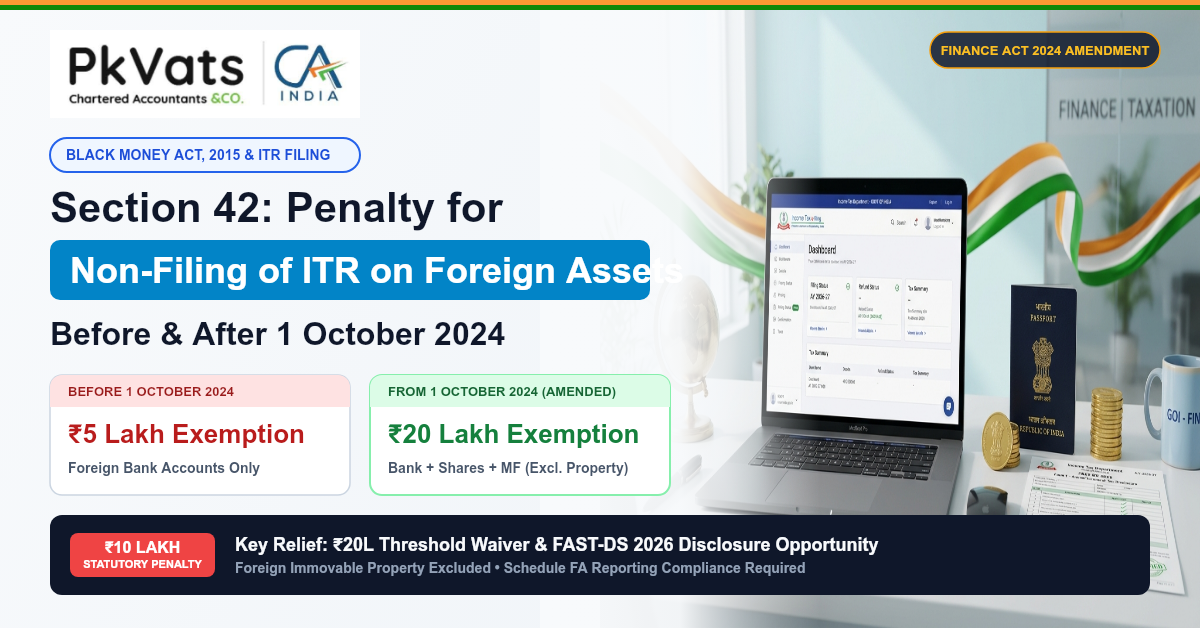
The exemption was available only in respect of one or more foreign bank accounts where the aggregate balance did not exceed ₹5 lakh at any time during the relevant previous year.
Key points:
- The exemption was restricted to foreign bank accounts.
- The aggregate balance of all qualifying foreign bank accounts should not exceed ₹5 lakh.
- Foreign shares, securities, mutual funds and other foreign assets were not covered by this specific exemption.
- Foreign immovable property was also not covered by the exemption.
Examples:
| Particulars | Value | Exemption prior to 1 Oct 2024 |
|---|---|---|
| Foreign bank account | ₹4 lakh | Exemption Available |
| Foreign bank accounts (aggregate) | ₹5 lakh | Exemption Available |
| Foreign bank account | ₹7 lakh | Exemption Not available |
| Foreign shares | ₹4 lakh | Exemption Not available |
| Foreign immovable property | ₹5 lakh | Exemption Not available |
Important: Under the earlier provision, the ₹5 lakh threshold was applicable only to foreign bank account balances, not to the aggregate value of all foreign assets.
3. Section 42 – Amended Provisions From 1 October 2024
The Finance (No. 2) Act, 2024 substituted the earlier provision to Section 42 with a broader exemption, effective from 1 October 2024.
Under the amended provision, Section 42 shall not apply where the aggregate value of foreign assets, other than immovable property, does not exceed ₹20 lakh.
Key changes:
- The exemption limit increased from ₹5 lakh to ₹20 lakh.
- The exemption is no longer restricted to foreign bank accounts.
- Foreign shares, securities, mutual funds and other qualifying foreign assets are also covered.
- The aggregate value of eligible foreign assets is considered.
- Foreign immovable property is specifically excluded from the ₹20 lakh exemption.
Examples:
| Particulars | Aggregate value | Exemption under amended provision |
|---|---|---|
| Foreign bank account | ₹15 lakh | Exemption Available |
| Foreign shares | ₹18 lakh | Exemption Available |
| Bank account + foreign shares | ₹19 lakh | Exemption Available |
| Bank account + shares | ₹25 lakh | Exemption Not available |
| Foreign immovable property | ₹5 lakh | Exemption Not available |
| Foreign immovable property | ₹20 lakh | Exemption Not available |
Important: The ₹20 lakh limit is an aggregate threshold for foreign assets other than immovable property. If the taxpayer holds foreign immovable property, the exemption cannot be claimed merely because its value is ₹ 1 lakh or ₹20 lakh.
4. Comparison: Section 42 Before and After 1 October 2024
| Basis | Before 01.10.2024 | From 01.10.2024 |
|---|---|---|
| Exemption limit | ₹5 lakh | ₹20 lakh |
| Bank accounts | Covered | Covered |
| Foreign shares | Not covered | Covered |
| Foreign mutual funds | Not covered | Covered |
| Other foreign assets | Not covered | Covered, subject to the provision |
| Immovable property | No exemption | No exemption |
| Threshold calculation | Aggregate bank balance | Aggregate value of eligible foreign assets |
5. Important Clarification Regarding Foreign Immovable Property
One of the most important aspects of the amendment is that the ₹20 lakh exemption does not extend to foreign immovable property.
For example:
Case 1: An individual holds a foreign bank account of ₹12 lakh and foreign shares worth ₹5 lakh.
Total foreign assets = ₹17 lakh.
The ₹20 lakh exemption may be available under the amended Section 42 (read our detailed guide on the ₹20 Lakh relief rule for foreign assets).
Case 2: An individual holds foreign immovable property worth ₹10 lakh.
Even though the property value is below ₹20 lakh, the exemption is not available because immovable property is specifically excluded.
Case 3: An individual holds foreign bank deposits worth ₹10 lakh and foreign immovable property worth ₹8 lakh.
The ₹20 lakh threshold does not provide protection for the immovable property. The foreign property remains outside the exemption.
6. Important: Section 42 and Section 43 Are Different
Taxpayers should also understand the difference between Sections 42 and 43 of the Black Money Act.
- Section 42: Penalty for failure to furnish the Income Tax Return where foreign assets or foreign income exist.
- Section 43: Penalty for failure to disclose information about foreign assets or for furnishing inaccurate particulars in an Income Tax Return that has been filed.
The Finance (No. 2) Act, 2024 amended the exemption provisos of both sections with effect from 1st October, 2024.
The ₹20 lakh exemption under these provisions should not be interpreted as a general exemption from foreign asset reporting requirements under Schedule FA (see our foreign company shares and Schedule FA reporting guide).
7. Who Should Consider the FAST-DS Scheme, 2026?
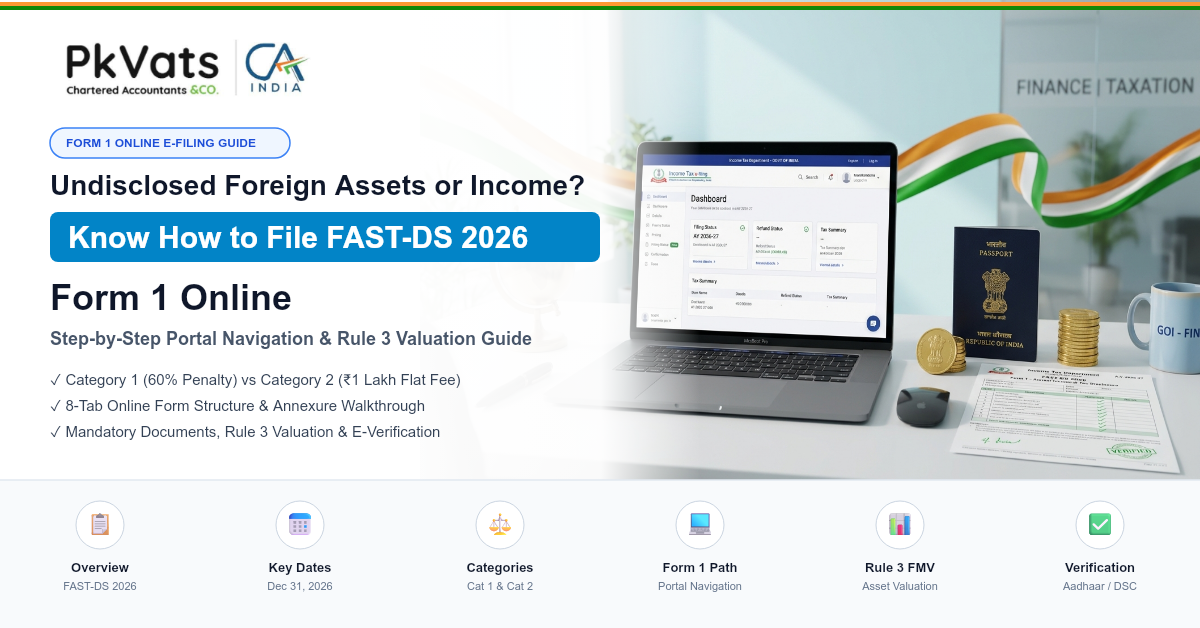
The Government introduced the Foreign Assets of Small Taxpayers – Disclosure Scheme (FAST-DS), 2026 as a one-time voluntary disclosure opportunity for eligible taxpayers.
The scheme allows eligible individuals to disclose certain foreign assets and foreign income that were not properly reported earlier.
It covers two broad situations:
• Category 1 – Undisclosed Foreign Assets or Income
Foreign assets acquired from sources for which the taxpayer cannot satisfactorily explain the investment.
Foreign income chargeable to tax in India but not offered to tax.
Aggregate value of the undisclosed foreign assets and income must not exceed ₹1 crore.
Amount payable: 30% tax plus an additional amount equal to the tax, resulting in an effective payment of 60% of the declared value or income (see Category 1 vs Category 2 fee calculation).
• Category 2 – Explained Foreign Assets but Reporting Lapse
Foreign assets acquired from income earned when the taxpayer was a non-resident, but not reported after becoming resident in India.
Foreign assets acquired from income already offered to tax in India but omitted from the relevant ITR schedule.
Aggregate value of foreign assets must not exceed ₹5 crore.
Amount payable: Fixed fee of ₹1 lakh.
Who is eligible?
A person may qualify if:
- They were resident in India in the previous year relevant to the undisclosed foreign income or asset; or
- They are currently non-resident or RNOR but were resident in India in the year to which the foreign income relates or in which the foreign asset was acquired.
A declaration may be considered where the taxpayer failed to file a return, filed a return but omitted the relevant foreign asset or income, or has income or assets that escaped assessment, subject to the statutory conditions.
Certain exclusions apply, including assets representing proceeds of crime in specified cases and assessment years for which assessment proceedings under the Black Money Act have already been completed.
8. FAST-DS Scheme – Eligibility Flowchart
The following flowchart provides a simplified overview of the eligibility process.
9. Important Dates and Filing Details
| Particulars | Details |
|---|---|
| Scheme | FAST-DS, 2026 |
| Commencement date | 16 August 2026 |
| Valuation date | 31 March 2026 |
| Declaration form | Form 1 |
| Last date for declaration | 31 December 2026 |
| Category 1 limit | ₹1 crore |
| Category 2 limit | ₹5 crore |
The declaration is filed electronically through the Income Tax e-Filing Portal under:
e-File → Income Tax Forms → File Income Tax Forms → Forms as per Other Acts → FAST-DS Form 1.
For step-by-step portal navigation and annexure walkthrough, see our step-by-step FAST-DS Form 1 e-filing guide.
10. Conclusion
The amendment to Section 42 of the Black Money Act, effective from 1 October 2024, provides significant relief to taxpayers by increasing the exemption threshold from ₹5 lakh to ₹20 lakh and extending it beyond foreign bank accounts to other foreign assets.
However, foreign immovable property remains outside this exemption, irrespective of its value.
Taxpayers should carefully review their foreign bank accounts, shares, investments, immovable properties and foreign income to ensure that all applicable disclosure requirements are fulfilled.
Eligible taxpayers with earlier reporting omissions should also evaluate the FAST-DS Scheme, 2026, before its closing date.
Need assistance with foreign asset disclosure, Black Money Act compliance or FAST-DS filing?
P.K. Vats & Co. can assist with reviewing foreign asset disclosures, assessing eligibility and providing professional Income Tax Advisory and Black Money Act compliance support.